Dione and SaturnDione and Saturn
<p></p> <p>Saturn has many, varied moons – over 60 have been discovered so far. One of the larger ones, Dione, is shown here in this image from the Cassini orbiter, pictured

<p></p> <p>Saturn has many, varied moons – over 60 have been discovered so far. One of the larger ones, Dione, is shown here in this image from the Cassini orbiter, pictured

<p></p> <p>Since its arrival at comet 67P/Churyumov-Gerasimenko, the European Space Agency’s Rosetta spacecraft has been surveying the surface and the environment of this curiously shaped body. But for a long time,

<p><a href="http://www.esa.int/var/esa/storage/images/esa_multimedia/images/2015/09/the_water-ice_cycle_of_rosetta_s_comet/15614542-3-eng-GB/The_water-ice_cycle_of_Rosetta_s_comet_large.jpg" target="_blank"></a></p> <p>ESA’s Rosetta spacecraft has provided evidence for a daily water-ice cycle on and near the surface of comets.</p> <p>Comets are celestial bodies comprising a mixture of dust and ices,

<p><a href="http://www.nasa.gov/sites/default/files/thumbnails/image/15-152.png" target="_blank"></a></p> <p><a href="http://www.nasa.gov/image-feature/the-icy-mountains-of-pluto" target="_blank">Icy mountains</a> on Pluto and a new, crisp view of its largest moon, <a href="http://www.nasa.gov/mission_pages/newhorizons/images/index.html?id=366737" target="_blank">Charon</a>, are among the several discoveries announced Wednesday by the NASA’s
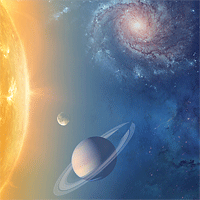
<p></p> <p>As NASA missions explore our solar system and search for new worlds, they are finding water in surprising places. Water is but one piece of our search for habitable planets
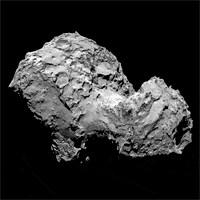
<p><a href="http://www.esa.int/var/esa/storage/images/esa_multimedia/images/2015/03/first_detection_of_molecular_nitrogen_at_a_comet/15318003-1-eng-GB/First_detection_of_molecular_nitrogen_at_a_comet.jpg" target="_blank" rel="nofollow"></a></p> <p>ESA’s Rosetta spacecraft has made the first measurement of molecular nitrogen at a comet, providing clues about the temperature environment in which Comet 67P/Churyumov–Gerasimenko formed.</p> <p>Rosetta arrived last
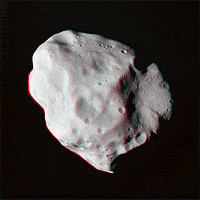
<p></p> <p>On Dec. 3, the Japan Aerospace Exploration Agency (JAXA) successfully launched its Hayabusa2 mission to rendezvous with an asteroid, land a small probe plus three mini rovers on its surface,

<p style="text-align: center;"></p> <p>The NASA and European Space Agency Cassini mission has revealed hundreds of lakes and seas spread across the north polar region of Saturn’s moon Titan. These lakes are
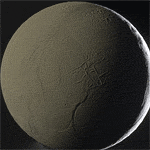
<p style="text-align:center"></p> <p>Saturn’s icy moon Enceladus has an underground sea of liquid water, according to the international Cassini spacecraft.</p> <p>Understanding the interior structure of 500 km-diameter Enceladus has been a top priority

<p style="text-align: center;"></p> <p>ESA’s Herschel space observatory has discovered water vapour around Ceres, the first unambiguous detection of water vapour around an object in the asteroid belt.</p> <p>With a diameter of 950