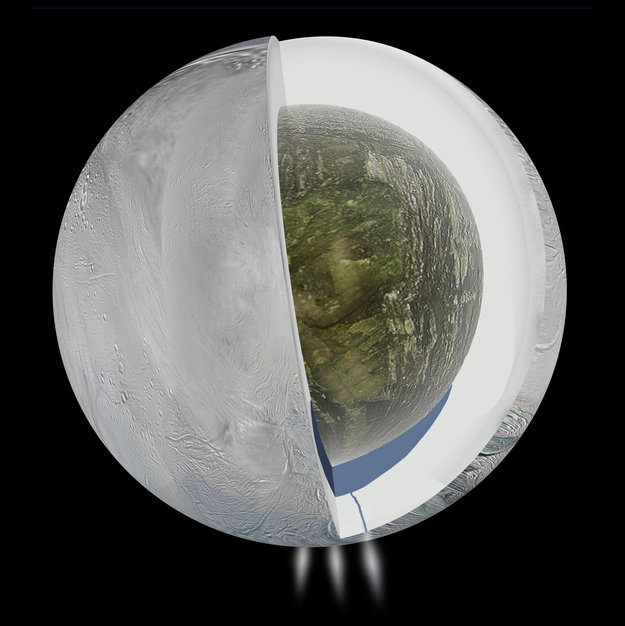
Saturn’s icy moon Enceladus has an underground sea of liquid water, according to the international Cassini spacecraft.
Understanding the interior structure of 500 km-diameter Enceladus has been a top priority of the Cassini mission since plumes of ice and water vapour were discovered jetting from ‘tiger stripe’ fractures at the moon’s south pole in 2005.
Subsequent observations of the jets showed them to be relatively warm compared with other regions of the moon and to be salty – strong arguments for there being liquid water below the surface.

Dramatic plumes, both large and small, spray water ice out from many locations along the ‘tiger stripes’ near the south pole of Saturn’s moon Enceladus. The tiger stripes are fissures that spray icy particles, water vapour and organic compounds. More than 30 individual jets of different sizes can be seen in this image, which is a mosaic created from two high-resolution images captured when Cassini flew past Enceladus and through the jets on 21 November 2009. This view was obtained at a distance of about 14 000 km from Enceladus. Image credit: NASA/JPL/Space Science Institute.
But planetary scientists have now been able to investigate the interior of the enigmatic moon directly, using Cassini’s radio science experiment.
On three separate occasions in 2010 and 2012, the spacecraft passed within 100 km of Enceladus, twice over the southern hemisphere and once over the northern hemisphere.
During the flybys, Cassini was pulled slightly off course by the moon’s gravity, changing its velocity by just 0.2–0.3 millimetres per second.
As tiny as these deviations were, they were detectable in the spacecraft’s radio signals as they were beamed back to Earth, providing a measurement of how the gravity of Enceladus varied along the spacecraft’s orbit. These measurements could then be used to infer the distribution of mass inside the moon.

As it swooped past the south pole of Saturn’s moon Enceladus on 14 July 2005, Cassini acquired high-resolution views of this puzzling ice world. From afar, Enceladus exhibits a bizarre mixture of softened craters and complex, fractured terrains. This large mosaic of 21 images has been arranged to provide a full-disc view of the anti-Saturn hemisphere on Enceladus. This mosaic is a false-colour view highlighting the long fractures – tiger stripes – in blue. Image credit: NASA/JPL/Space Science Institute
For example, a higher-than-average gravity ‘anomaly’ might suggest the presence of a mountain, while a lower-than-average reading implies a mass deficit.
On Enceladus, the scientists measured a negative mass anomaly at the surface of the south pole, accompanied by a positive one some 30-40 km below.
“By analysing the spacecraft’s motion in this way, and taking into account the topography of the moon we see with Cassini’s cameras, we are given a window into the internal structure of Enceladus,” says Luciano Iess, lead author of the results published in Science.
“The perturbations in the spacecraft’s motion can be most simply explained by the moon having an asymmetric internal structure, such that an ice shell overlies liquid water at a depth of around 30–40 km in the southern hemisphere.”
While the gravity data cannot rule out a global ocean, a regional sea extending from the south pole to 50ºS latitude is most consistent with the moon’s topography and high local temperatures observed around the tiger stripes.
“This experiment provides a crucial new piece of information towards understanding the formation of plumes on this intriguing moon,” says Nicolas Altobelli, ESA’s Cassini project scientist.
Top image: Artist’s impression of the possible interior of Enceladus based on Cassini’s gravity investigation. The data suggest an ice outer shell and a low-density, rocky core with a regional water ocean sandwiched between at high southern latitudes. Cassini images were used to depict the surface geology in this artwork. The mission discovered plumes of ice and water vapour jetting from fractures – nicknamed ‘tiger stripes’ – at the moon’s south pole in 2005.Image credit: NASA/JPL-Caltech
Have something to add to this story? Share it in the comments.
Filed under: Saturn