The Sky This Month
| Daily Lunar Phases This Month | |||||
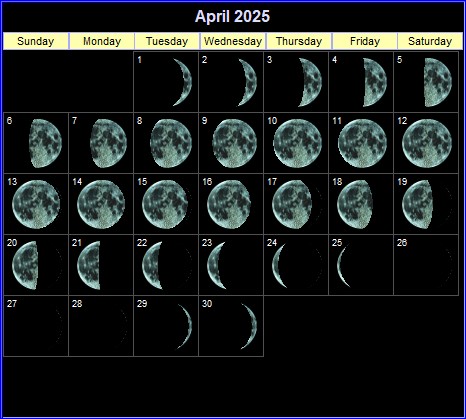 Diagram created with LunarPhase Pro |
|||||
| Times For Emerging Crescent Moons | |||||
| Below are times for viewing Crescent Moons in UT for Dublin, Ireland. Crescent data is specific for your location but adding your timezone offset from GMT to the Sunset and Moonset times will give you an idea of when the Moon is visible locally. The amount of time you have to see a crescent and what percentage of the Moon is illuminated will be somewhat different for where you live. LunarPhase Pro will calculate all this information specifically for your location. The data in the screenshot below was generated by the software. | |||||

| Events for October, 2026 | |||||
|
NASA What’s Up In October, 2026 BBC Sky At Night: What’s In The The Night Sky For October, 2026 High Point Scientific | What’s in the sky October, 2026? October, 2026 Podcasts:The Jodcast - from Jodrell Bank in the UK. For more information about what's happening this month, visit the Jodcast October page.What Messier Objects Are Visible This Month (October, 2026):A list of messier objects visible this month. All are possible with binoculars, most are easy even with small binoculars. As summer turns to fall we complete our tour of the wonders in Sagittarius. Sixteen Messier objects are found within the constellation of Sagittarius, we will seek the six that remain to be seen on our tour. We will also search for three others just north of Sagittarius in the Milky Way. Our October tour includes two nebulae and the clusters that power them, four open clusters, a star cloud, and lastly two globular clusters. All of these objects are possible in binoculars, most are easy in even small binoculars. Several of these are also possible naked eye objects.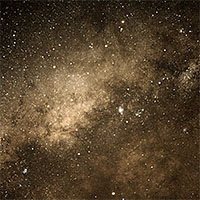 M24
This "object" is actually a section of the Milky Way in Sagittarius. It is easily seen with the naked eye as a fuzzy, oval patch about four times the size of the full moon. The best views are through binoculars or rich field telescopes. M24
This "object" is actually a section of the Milky Way in Sagittarius. It is easily seen with the naked eye as a fuzzy, oval patch about four times the size of the full moon. The best views are through binoculars or rich field telescopes.
 M25
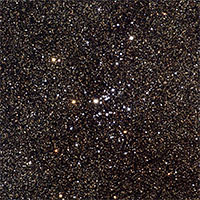
Just east of M24 in Sagittarius we find this open cluster. Visible to the naked eye, M25 lies in the same binocular field as M24. In binoculars it appears as a partially resolved star cluster buried in faint nebulosity. A view through a telescope shows the nebulosity is in fact many faint stars that are not resolved in small instruments. M25
Just east of M24 in Sagittarius we find this open cluster. Visible to the naked eye, M25 lies in the same binocular field as M24. In binoculars it appears as a partially resolved star cluster buried in faint nebulosity. A view through a telescope shows the nebulosity is in fact many faint stars that are not resolved in small instruments.
 M18
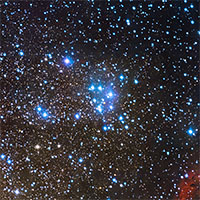
This is a small open cluster just north of M24 in Sagittarius. In binoculars M18 is easy to see as a small fuzzy patch of light in the same field of view as M24. Telescopes reveal this cluster for what it is, a small, sparse collection of fairly bright stars.icult binocular object, look for a small fuzzy patch of light. Through a telescope M14 is an even patch of light, the stars not resolvable except through large scopes. M18
This is a small open cluster just north of M24 in Sagittarius. In binoculars M18 is easy to see as a small fuzzy patch of light in the same field of view as M24. Telescopes reveal this cluster for what it is, a small, sparse collection of fairly bright stars.icult binocular object, look for a small fuzzy patch of light. Through a telescope M14 is an even patch of light, the stars not resolvable except through large scopes.
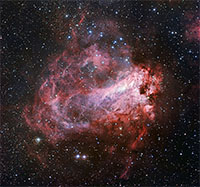 M17
Just north of M18 and in the same binocular field as M24 and M18 lies the Omega nebula. Possible to see with the naked eye and easy with binoculars, this nebula appears as a small faint patch of fuzz. A telescope will show the unique V shape nebulosity that gives the cluster its name. The shape reminds me of a swan with two bright stars that power the cluster embedded in the head and neck of the swan. M17
Just north of M18 and in the same binocular field as M24 and M18 lies the Omega nebula. Possible to see with the naked eye and easy with binoculars, this nebula appears as a small faint patch of fuzz. A telescope will show the unique V shape nebulosity that gives the cluster its name. The shape reminds me of a swan with two bright stars that power the cluster embedded in the head and neck of the swan.
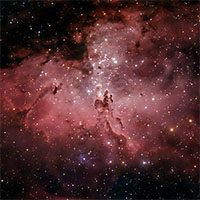 M16
Continuing north of M17 we find another nebula in Serpens. To the naked eye and binoculars, this small patch of haze is very similar in appearance to M17 which is in the same binocular field of view. Through a telescope the M16 looks like a sparse open cluster of stars surrounded by faint wisps of smoke. M16
Continuing north of M17 we find another nebula in Serpens. To the naked eye and binoculars, this small patch of haze is very similar in appearance to M17 which is in the same binocular field of view. Through a telescope the M16 looks like a sparse open cluster of stars surrounded by faint wisps of smoke.
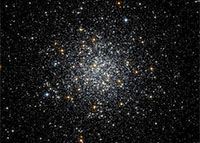 M26
Continuing to head north through the Milky Way we find this open cluster in the constellation Scutum. This is a difficult object to find in binoculars, but possible as a faint patch of fuzz. Telescopes partially resolve this cluster and show several stars buried in a faint glow from the unresolved stars. M26
Continuing to head north through the Milky Way we find this open cluster in the constellation Scutum. This is a difficult object to find in binoculars, but possible as a faint patch of fuzz. Telescopes partially resolve this cluster and show several stars buried in a faint glow from the unresolved stars.
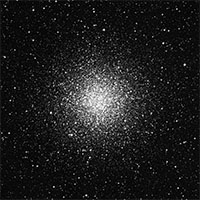
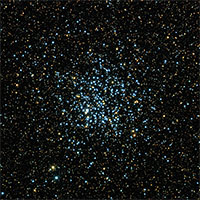 M11
Just north of M26 in Scutum lies the Wild Duck Cluster. Possible to see with the naked eye, binoculars show a small faint patch surrounding a bright star. Telescopes resolve many of the stars in this very rich cluster. M11
Just north of M26 in Scutum lies the Wild Duck Cluster. Possible to see with the naked eye, binoculars show a small faint patch surrounding a bright star. Telescopes resolve many of the stars in this very rich cluster.
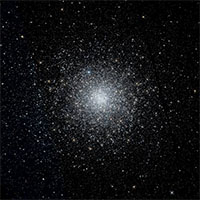
 M55
Dipping back into Sagittarius we find two more globular clusters waiting for us. The first is one of the brightest and largest globulars in the catalogue. Possible to see naked eye, it is an easy binocular object appearing as a bright fuzzy ball of light. Telescopes show a round patch of light bright in the center and fading toward the edges. Large aperatures are needed to resolve this globular. M55
Dipping back into Sagittarius we find two more globular clusters waiting for us. The first is one of the brightest and largest globulars in the catalogue. Possible to see naked eye, it is an easy binocular object appearing as a bright fuzzy ball of light. Telescopes show a round patch of light bright in the center and fading toward the edges. Large aperatures are needed to resolve this globular.
 M75
The last object of the month, and the last object to be visited in Sagittarius. In binoculars, M75 is not too hard to see, look for a small fuzzy star. A telescope will show a small fuzz ball with a bright center. M75
The last object of the month, and the last object to be visited in Sagittarius. In binoculars, M75 is not too hard to see, look for a small fuzzy star. A telescope will show a small fuzz ball with a bright center.
Other Events To Watch Out For This Month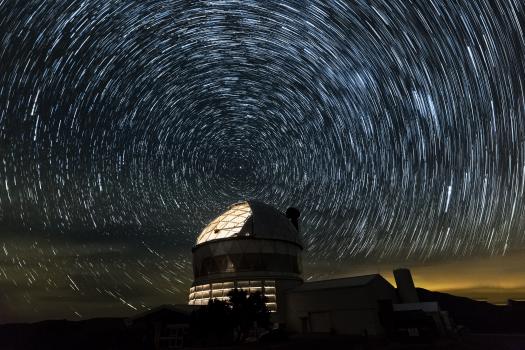 Orionid Meteors2026-10-19 05:00 StarDate Some high-speed bullets are firing across the night sky this week. They’re the bits of debris that produce the Orionid meteor shower – small pebbles left behind by Comet Halley. They hit the atmosphere at... Meteor’ology2026-10-18 05:00 StarDate Meteorology is the study of Earth’s atmosphere and its weather and climate. Despite the name, it has nothing to do with meteors – at least not directly. But more broadly, meteors and meteorology are related... 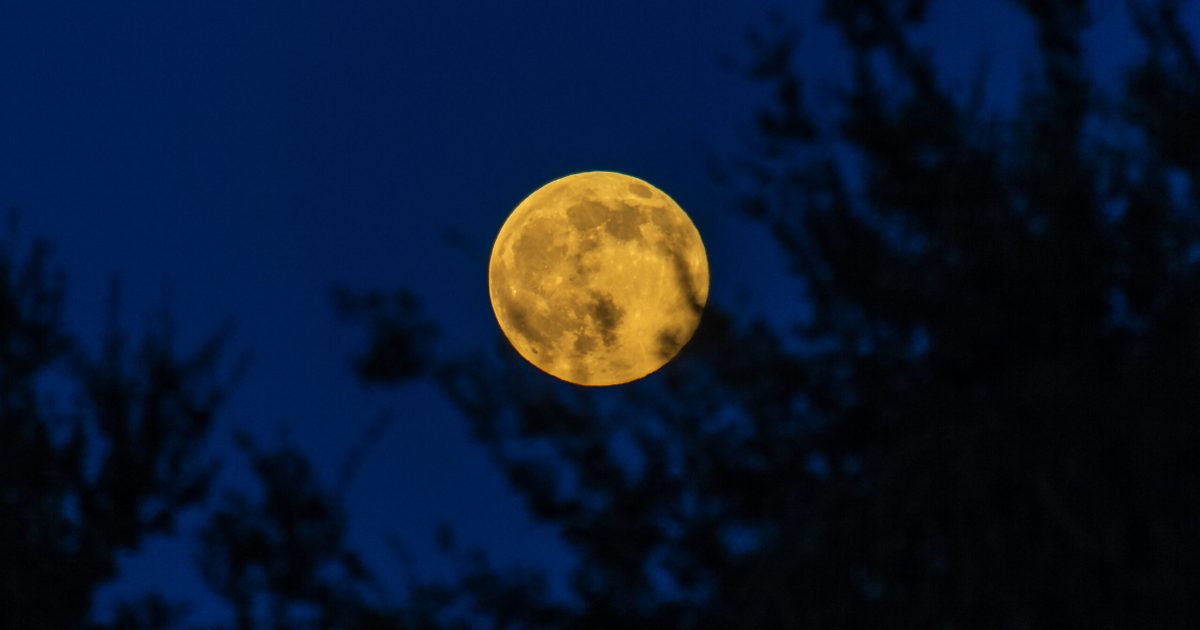 2026 Full Moon calendar: When to see the Full Moon and phases2026-10-20 13:09 Astronomy Magazine The phenomenon of a Full Moon arises when our planet, Earth, is precisely sandwiched between the Sun and the Moon. This alignment ensures the entire side of the Moon that faces us gleams under sunlight.... 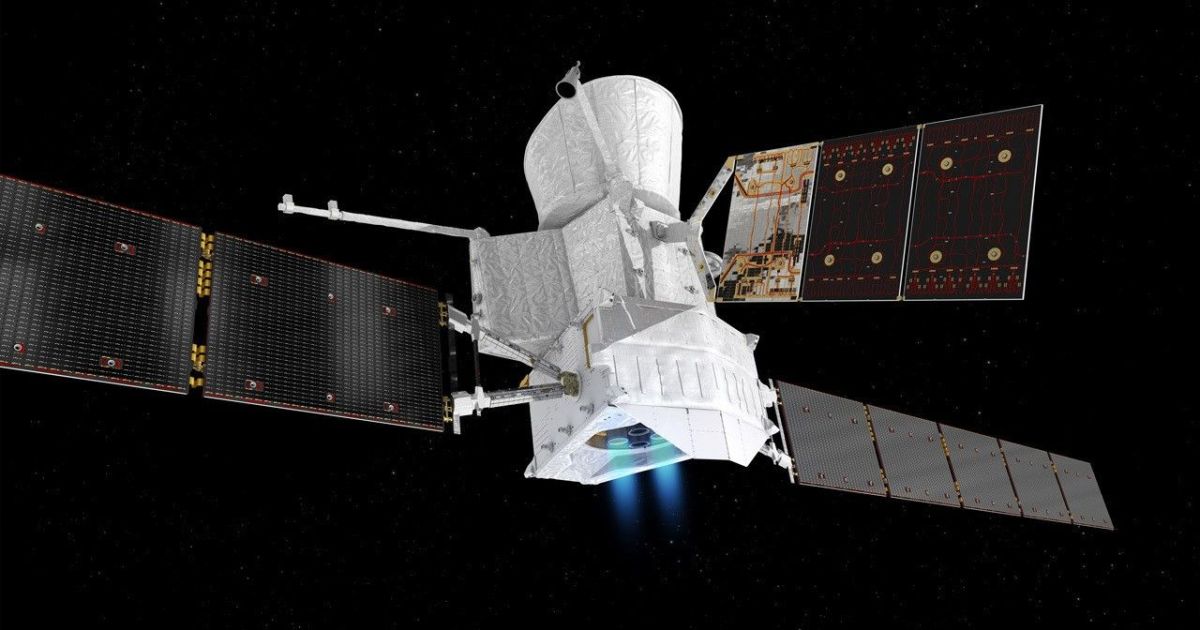 Oct. 20, 2018: BepiColombo launches2026-10-20 13:00 Astronomy Magazine BepiColombo, a joint mission of the European Space Agency and the Japan Aerospace Exploration Agency, launched Oct. 20, 2018. The spacecraft is actually two satellites in one, the Mercury Planetary Orbiter (MPO) and the Mercury...
|
|||||
| Daily / Weekly Notes | |||||
| Today’s Sky Event from Earth& Sky A different astronomical event is described each day |
|||||
This Week’s “Sky at a Glance”
From Sky & Telescope
AMS Meteor Activity Outlook
A weekly preview of meteor activity
| Monthly Notes | |||||
Sky at Night  Catch up on the latest edition of the BBC Programme. Episodes are now unforunately only playable using the BBC’s iPlayer so you’ll need a VPN set to a UK IP address to watch them. |
|||||
Stardate Daily Programme Calendar 
Monthly listing of aired programs from StarDate
| Satellite Predictions and Visibility | |||||
| Spot The Station NASA SkThus web-based application provides sky watchers worldwide with a picture of when and where the International Space Stationcan be seen with the unaided eye as it passes overhead. |
|||||
Heavens Above
Provides all the information you need to observe satellites such as the International Space Station and the Space Shuttle, spectacular events such as the dazzlingly bright flares from Iridium satellites as well as a wealth of other spaceflight and astronomical information.
| Online Skymaps and Charts | |||||
| Your Sky An interactive planetarium run by Fourmilab. You can produce maps for any time and date, viewpoint, and observing location. If you enter the orbital elements of an asteroid or comet, Your Sky will compute its current position and plot it on the map. Each map is accompanied by an ephemeris for the Sun, Moon, planets, and any tracked asteroid or comet. A control panel permits customization of which objects are plotted, limiting magnitudes, colour scheme, image size, and other parameters. |
|||||
Daily predictions for brighter satellites (Heavens Above)
Provides a range of charts and information, including sky charts for your location (which you’ll have to specify).
| Observing Resources | |||||
| Meteor Showers (International Meteor Organization) A listing of meteor showers that occur throughout the year. |
|||||
Recent International Astronomical Union Circulars
This page lists the dates of issue and the titles of the items on the twenty most-recent IAUCs. Individual items can be displayed by selecting the relevant title. Note: These circulars went behind a paywall in 2017 and only those with a subscription can see new ones.
Minor Planet Center: Recent MPECs
This list gives the dates of issue, titles and details of the items on the fifty most-recent MPECs.
Current Observable Comets
Lists links to orbital elements and ephemerides of (potentially) observable comets. Here is an alternative, less technical site.
BAA Comet Section
lists links to news, current magnitudes and ephemerides of currently observable comets.
American Association of Variable Star Observers
The AAVSO is the largest organization of variable star observers worldwide. You can get daily updates and find out more about them, the projects they sponsor and the data they make available to astronomers around the world.
The Minima of Algol
The star Algol (Beta Persei) was the first eclipsing variable star ever discovered, and it’s still the most famous one. You can check on it whenever you step outdoors on nights when Perseus is in view.
International Occultation and Timing Association
This page gives information on the circumstances of lunar and other types of occultation for various locations around the world.
SEDs Messier Catalog
A listing of images and information on the Messier objects with links to other deep sky catalogues (NGC objects, etc.)
The Interactive NGC Catalog Online
An interactive NGC (IC, and Messier) catalog at SEDS, based on the famous NGC 2000.0 by R.W. Sinnott of Sky Publishing Corp.
The Sky Live
Online simulator shows upcoming close approaches between Earth and NEO (Near Earth Object) Asteroids; find information, position data and sky charts for Planets, Asteroids, Comets, Interplanetary Probes; Use the Observing Guide to plan observations of Solar System objects visible tonight from your location; create accurate and interactive maps of the sky visible from any location up to the year 2035; has a 3D Solar System Simulator.
The Sky at Night
The BBC’s dedicated Sky at Night website. Contains past episodes and other video material.
I was wondering if you know what the light that streaked across northern Illinois Dec 7 2011 at around 10:40 – 10:50 PM was?
My daughter and I saw it while driving on interstate 57 N just past Champaign. She thought it was a shooting star but this light was very bright colorful and just too big (or close?) to be a shooting star. I have never seen anything like it. Has anyone figured out what it was?
Looks like there was a bright fireball over Illinois on Dec. 7th. Though not frequent, these can be surprisingly bright and can even cast shadows. You can read more about fireballs here: http://www.amsmeteors.org/fireballs/faqf/