Clockwise from top: ESA’s Matthias Maurer, Lina Tomelleri, Giorgio Tomelleri, Anna Maria Fioretti from the Institute of Geosciences and Earth Resources (IGG), an institute of National Research Council of Italy, and ESA astronauts Pedro Duque and Luca Parmitano.

The group are posing with meteorites during the Pangaea course that is teaching astronauts how to identify interesting rock samples, as well …

Read the rest of this article

Waking up before sunrise is a good way to get a head start on the day. On Oct. 21st, waking up before sunrise could stop you in your tracks.

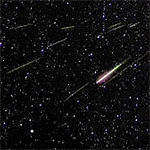
Blame Halley’s Comet. Every year in mid-to-late October, Earth passes through a stream of dusty debris from Comet Halley, and the pre-dawn sky can light up with a pretty display of …

Read the rest of this article

Astronomers using ESA’s Herschel space observatory to probe the turbulent beginnings of a Sun-like star have found evidence of mighty stellar winds that could solve a puzzling meteorite mystery in our own back yard.

In spite of their tranquil appearance in the night sky, stars are scorching furnaces that spring to life through tumultuous processes – and our 4.5 billion-year-old …

Read the rest of this article

This weekend, Earth will pass through a stream of debris from Comet 209P/LINEAR.

If forecasters are correct, the encounter could produce an outburst of bright meteors numbering more than 200 per hour.

Most models agree that peak rates should occur between the hours of 0600 UT and 0800 UT (2 a.m. and 4 a.m. EDT) on Saturday morning, May 24th, …

Read the rest of this article

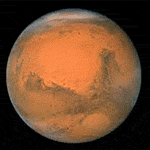
The Planet Mars

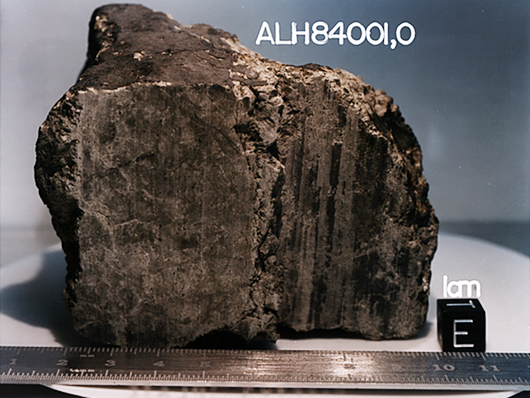
A team of scientists at NASA’s Johnson Space Center in Houston and the Jet Propulsion Laboratory in Pasadena, Calif., has found evidence of past water movement throughout a Martian meteorite, reviving debate in the scientific community over life on Mars.

In 1996, a group of scientists at Johnson led by David McKay, Everett Gibson and Kathie Thomas-Keprta published an article …

Read the rest of this article

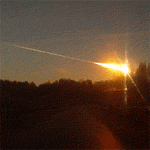
Nine months after the incredible air blast of a meteor over Chelyabinsk, Russia, scientists at the Geological Society of America meeting are reporting that the frequency of such air bursts is probably underestimated and these events are more damaging than comparable nuclear blasts.

It was on Feb. 15, 2013, that the infamous asteroid exploded in the air about 40 kilometers …

Read the rest of this article

Just before midnight on Sept. 27-28, sky watchers in more than a dozen US states witnessed a bright flash of light. NASA all-sky cameras recorded a brilliant fireball, which analysts believe was a meter-class space rock exploding almost directly above Columbus, Ohio.

Witnesses reported shadows cast upon the ground, unusual sounds, and a swirling contrail marking the aftermath of the …

Read the rest of this article

Two nights ago, a ~100 lb meteoroid traveling 53,000 mph hit the atmosphere over the southeastern USA and exploded around 2:30 AM on August 28th, producing sonic booms and a fireball as bright as a full Moon. Researchers are now scouring the countryside for fragments that could reveal the nature and origin of the meteoroid.

NASA’s Meteoroid Environment Office has …

Read the rest of this article

Atmospheric physicist Nick Gorkavyi missed witnessing an event of the century last winter when a meteor exploded over his hometown of Chelyabinsk, Russia. From Greenbelt, Md., however, NASA’s Gorkavyi and colleagues witnessed the atmospheric aftermath. The explosion created a never-before-seen belt of “meteor dust” that circulated through the stratosphere for at least three months.

Shortly after dawn on Feb. 15, …

Read the rest of this article

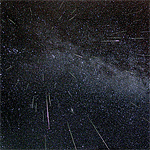
One of the best meteor showers of the year – the Perseids – will hit their peak tonight (August 11/12). And even if you’re clouded out, suffer from light polution or are surrounded by city lights, you can still have a front row seat. This weekend, NASA are streaming its first Perseid webcast.

The camera activates at full dusk (approx. …

Read the rest of this article