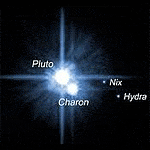
Closeup of Pluto

Icy mountains on Pluto and a new, crisp view of its largest moon, Charon, are among the several discoveries announced Wednesday by the NASA’s New Horizons team, just one day after the spacecraft’s first ever Pluto flyby.


A portrait from the final approach. Pluto and Charon display striking color and brightness contrast in this composite image from July 11, …

Read the rest of this article

Closeup of Pluto

NASA’s New Horizons spacecraft is at Pluto.

After a decade-long journey through our solar system, New Horizons made its closest approach to Pluto Tuesday, about 7,750 miles above the surface — roughly the same distance from New York to Mumbai, India – making it the first-ever space mission to explore a world so far from Earth.

I’m delighted at

Read the rest of this article

NASA

NASA will provide comprehensive television, Internet and social media coverage this week of the agency’s New Horizons spacecraft historic July 14 flyby of Pluto. The time for the flyby preview news briefing on NASA Television Monday, July 13 has moved up 30 minutes, and now will start at 10:30 a.m. EDT (15:30 BST).

The schedule for events coverage is subject …

Read the rest of this article

Pluto Geology

It began as a point of light. Then, it evolved into a fuzzy orb. Now – in its latest portrait from NASA’s New Horizons spacecraft – Pluto is being revealed as an intriguing new world with distinct surface features, including an immense dark band known as the “whale.”

As the newest black and white image from New Horizons’ Long Range …

Read the rest of this article

Pluto and Charon

What’s icy, has “wobbly” potato-shaped moons, and is the world’s best-known dwarf planet? The answer is Pluto, and NASA’s New Horizons is speeding towards the edge of our solar system for a July 14 flyby. It won’t be making observations alone; NASA’s fleet of observatories will be busy gathering data before and after to help piece together what we know …

Read the rest of this article

New Horizons Pluto Flyby

NASA is inviting media to cover New Horizons’ historic Pluto flyby in mid-July, including the spacecraft’s closest approach to Pluto on July 14, from the Johns Hopkins University Applied Physics Laboratory (APL) in Laurel, Maryland, site of the mission operations center.

Media who wish to cover the events at APL must receive accreditation from the APL Public Affairs Office by …

Read the rest of this article

New Horizons Pluto Flyby

After a voyage of nearly nine years and three billion miles —the farthest any space mission has ever traveled to reach its primary target – NASA’s New Horizons spacecraft came out of hibernation on Dec. 6th for its long-awaited 2015 encounter with the Pluto system.

Operators at the Johns Hopkins University Applied Physics Laboratory in Laurel, Md., confirmed at 9:53 …

Read the rest of this article

New Horizons Pluto Flyby

NASA’s Pluto-bound New Horizons spacecraft has traversed the orbit of Neptune. This is its last major crossing en route to becoming the first probe to make a close encounter with distant Pluto on July 14, 2015.

The sophisticated piano-sized spacecraft, which launched in January 2006, reached Neptune’s orbit — nearly 2.75 billion miles from Earth — in a record eight …

Read the rest of this article

Pluto and Charon

ESA’s Herschel space observatory has observed 132 of the known 1400 cold worlds that inhabit a region of the Solar System beyond the orbit of Neptune, some 4.5–7.5 billion km from the Sun.

These ‘trans-Neptunian objects’, or TNOs, include worlds such as Pluto, Eris, Haumea and Makemake, and make up a vast population of such objects thought to occupy these …

Read the rest of this article

Pluto and Charon

When NASA’s New Horizons mission was launched, Pluto was still considered one of the nine planets in our solar system. It has since been reclassified as a “Dwarf Planet” in a solar system of eight planets.

One of the fastest spacecraft ever built, New Horizonsis hurtling through the void at nearly one million miles per day. Launched in 2006, it …

Read the rest of this article