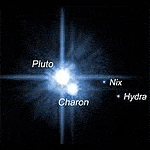
Pluto’s Moons Need Names and That Honor Has Fallen to You!
Pluto may have been demoted, but its family is getting bigger and bigger. Now, two of the dwarf planet’s tiniest moons need names — but rather…
Read the articlePluto may have been demoted, but its family is getting bigger and bigger. Now, two of the dwarf planet’s tiniest moons need names — but rather…
Read the articleA team of astronomers using NASA’s Hubble Space Telescope has discovered another moon orbiting the dwarf planet Pluto. They say the new moon, Pluto’s 5th, is…
Read the articleNASA’s New Horizons mission reached a special milestone yesterday, Dec. 2, 2011, on its way to reconnoiter the Pluto system, coming closer to Pluto than any…
Read the articleThe NASA/ESA Hubble Space Telescope has discovered a new moon circling Pluto. P4, as it is currently called, is the smallest moon yet found orbiting Pluto,…
Read the articleLonely Pluto floats in the darkness at the edge of our solar system. It’s so far away even the Hubble Space Telescope has trouble making out…
Read the articlePluto is the second-largest known dwarf planet in the Solar System (after Eris) and the tenth-largest body observed directly orbiting the Sun. Originally classified as a…
Read the article