MESSENGER Mercury FlybyMESSENGER Mercury Flyby
<p>On Monday, Jan. 14, a pioneering NASA spacecraft was the first to visit Mercury in almost 33 years when it soared over the planet to explore and snap close-up images
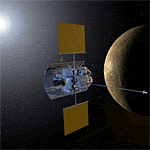
<p>On Monday, Jan. 14, a pioneering NASA spacecraft was the first to visit Mercury in almost 33 years when it soared over the planet to explore and snap close-up images
<p><b>Jan. 26, 2010:</b> After six years of unprecedented exploration of the Red Planet, NASA’s Mars Exploration Rover Spirit no longer will be a fully mobile robot. NASA has designated the
<p>It rises in the east at sunset, pumpkin-orange and brighter than a first magnitude star. You stare at it, unblinking. Unblinking, it stares right back.</p> <p>It is Mars.</p> <p>This week Earth and
<p>The Moon is about to pass directly in front of the sun, producing an <a href="http://eclipse.gsfc.nasa.gov/SEgoogle/SEgoogle2001/SE2010Jan15Agoogle.html" target="_blank">annular solar eclipse</a> on Jan. 15th between 05:00 and 09:00 GMT.</p> <p>The zone of visibility
<table align="right" width=280 cellpadding=5 cellspacing=0 border=0> <tr> <td align=center> <p class=small><br /> An artist’s concept of an exoplanet. Image credit: ESO.</p></td> </tr> </table> <p><b>January 14, 2010:</b> The premiere observatory of the next decade, the James Webb Space
<p>A curious object is about to fly past Earth only one-third the distance to the Moon. </p> <p>Cataloged as a 10m-class asteroid, <a target="_blank" href="http://www.cfa.harvard.edu/mpec/K10/K10A59.html">2010 AL30</a> has an orbital period of
<p>This striking image taken by NASA’s Terra satellite on 7 January shows the UK deep in the clutches of the current cold snap. While the UK is completely white, Ireland,
<p>NASA’s Kepler space telescope, designed to find Earth-size planets in the habitable zone of sun-like stars, has discovered its first five new exoplanets, or planets beyond our solar system.</p> <p>Kepler’s high