Sentinel-1B Launch

This timelapse video shows Sentinel-1B, from final preparations to liftoff on a Soyuz launcher from Europe’s Spaceport in French Guiana, on 25 April 2016 at 21:02 GMT (23:02 CEST).

With the Sentinel-1 mission designed as a two-satellite constellation, Sentinel-1B will join its identical twin, Sentinel-1A, which was launched two years ago from Kourou.

Both satellites carry an advanced radar that …

Read the rest of this article

Satellite image of Ireland

The Sentinel-1A satellite takes us over to Ireland, in this multi-temporal colour composite of land coverage across the island. (Download a hired image here).

With a coastline of 7500 km, Ireland is home to some 4.8 million people and a wealth of history and tradition.

Stretching 486 km from north to south and 275 km across, Ireland is …

Read the rest of this article

Manicouagan Crater

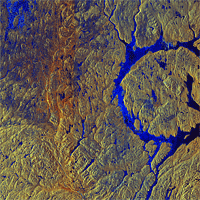
This false-colour image featuring the Manicouagan Crater was captured by the Sentinel-1A satellite on 21 March.

Carved out by an asteroid strike some 214 million years ago, this crater in Quebec, Canada is known to be one of the oldest and largest impact craters on the planet. Experts believe that glaciers have since played a large part in its erosion.…

Read the rest of this article

Wht Space Matters

NASA and the United Nations Office for Outer Space Affairs (UNOOSA) have launched a global photography competition to highlight how the vantage point of space helps us better understand our home planet, improve lives, and safeguard our future by aiding sustainable development on Earth.

To highlight the role of space-based science and technologies and their applications on Earth, NASA and …

Read the rest of this article

Earth Day 2015

Registration is open for a free online course that provides an introduction to monitoring climate change using satellite Earth observation.

ESA has teamed up with FutureLearn, a leading online learning platform, to offer the ‘Monitoring Climate from Space’ course beginning on 8 June.

From their vantage point some 800 km above Earth, satellites provide crucial information on our planet’s land, …

Read the rest of this article

Earth Day 2015

There are (so far) 1,800 known planets beyond our solar system, but among all of them, there’s no place like Earth. This Earth Day, April 22, NASA is asking you to share pictures and video of your favorite places on Earth using social media – and tag them #NoPlaceLikeHome.

The project seeks to get the public involved in highlighting the …

Read the rest of this article

Earth Day 2015

Droughts in the U.S. Southwest and Central Plains during the last half of this century could be drier and longer than drought conditions seen in those regions in the last 1,000 years, according to a new NASA study.

The study, published Thursday in the journal Science Advances, is based on projections from several climate models, including one sponsored by NASA. …

Read the rest of this article

NASA research shows Earth’s atmosphere contains an unexpectedly large amount of an ozone-depleting compound from an unknown source decades after the compound was banned worldwide.

Carbon tetrachloride (CCl4), which was once used in applications such as dry cleaning and as a fire-extinguishing agent, was regulated in 1987 under the Montreal Protocol along with other chlorofluorocarbons that destroy ozone and contribute …

Read the rest of this article

Earth Day 2015

Measurements from ESA’s CryoSat mission have been used to map the height of the huge ice sheets that blanket Greenland and Antarctica and show how they are changing. New results reveal combined ice volume loss at an unprecedented rate of 500 cubic kilometres a year.

The research was carried out by Germany’s Alfred Wegener Institute Helmholtz Centre for Polar and …

Read the rest of this article

Faced with the challenge of capturing tumbling satellites to clear key orbits, ESA is considering turning to an ancient terrestrial technology: the harpoon.

Used since the Stone Age, first to spear fish and later to catch whales, the humble harpoon is being looked at for snagging derelict space hardware.

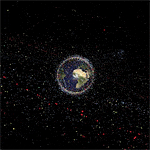
Decades of launches have left Earth surrounded by a halo of …

Read the rest of this article