Stellar Life and Death in Abell 78Stellar Life and Death in Abell 78
<p></p> <p>Beneath the vivid hues of this eye-shaped cloud, named Abell 78, a tale of stellar life and death is unfolding. At the centre of the nebula, a dying star –

<p></p> <p>Beneath the vivid hues of this eye-shaped cloud, named Abell 78, a tale of stellar life and death is unfolding. At the centre of the nebula, a dying star –

<p style="text-align: center;"></p> <p>Astronomers using ESA’s Integral gamma-ray observatory have demonstrated beyond doubt that dead stars known as white dwarfs can reignite and explode as supernovae. The finding came after the

<p style="text-align:center"></p> <p>New data from NASA’s Chandra X-ray Observatory offer a glimpse into the environment of a star before it exploded earlier this year, and insight into what triggered one of
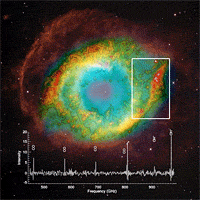
<p style="text-align:center"></p> <p> Using ESA’s Herschel space observatory, astronomers have discovered that a molecule vital for creating water exists in the burning embers of dying Sun-like stars.</p> <p>When low- to middleweight stars
<p><a href="http://www.jpl.nasa.gov/spaceimages/images/mediumsize/PIA17847_ip.jpg" target="_blank"></a></p> <p>The closest supernova of its kind to be observed in the last few decades has sparked a global observing campaign involving legions of instruments on the ground and
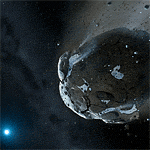
<p style="text-align:center"></p> <p>Astronomers using NASA’s Hubble Space Telescope have found the building blocks of solid planets that are capable of having substantial amounts of water. This rocky debris, currently orbiting a

<p style="text-align:center"></p> <p>A spectacular Nova explosion in constellation Delphinus was discovered on August 14th – SLOOH covered it live yesterday to showing this amazing event as it happened in true color
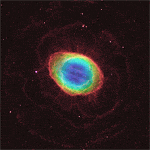
<p style="text-align:center" class="small"><br /> <em>In this composite image, visible-light observations by NASA’s Hubble Space Telescope are combined with infrared data from the ground-based Large Binocular Telescope in Arizona to assemble a
<p>Taking 290 million years to reach Earth, last month that light from a supernova explosion was spotted by an Irish amateur astronomer in his backyard observatory.</p> <p align=center class=small><br /> David Grennan’s
<table align=right width=340> <tr> <td width=8></td> <td align=center> <p class=small><br />Artist’s illustration of supernova SN 2006gy<br /> Credit: Illustration: NASA/CXC/M.Weiss; X-ray: NASA/CXC/UC Berkeley/N.Smith et al.; IR: Lick/UC Berkeley/J.Bloom & C.Hansen</p></td> </tr> </table> <p>The brightest stellar explosion ever recorded