Hitchhiking Between Comets and AsteroidsHitchhiking Between Comets and Asteroids
<p></p> <p>Catching a ride from one solar system body to another isn’t easy. You have to figure out how to land your spacecraft safely and then get it on its way

<p></p> <p>Catching a ride from one solar system body to another isn’t easy. You have to figure out how to land your spacecraft safely and then get it on its way

<p></p> <p>Fast-moving magnetic waves emanating from a distant supermassive black hole undulate like a whip whose handle is being shaken by a giant hand, according to a new study using data

<p></p> <p>The ghostly shells of galaxy ESO 381-12 are captured here in a new image from the NASA/ESA Hubble Space Telescope, set against a backdrop of distant galaxies. The strikingly uneven

<p></p> <p>This image, based on housekeeping data from ESA’s Gaia satellite, is no ordinary depiction of the heavens. While the image portrays the outline of our Galaxy, the Milky Way, and

<p></p> <p>Astronomers using NASA’s Chandra X-ray Observatory have discovered the largest and brightest set of rings from X-ray light echoes ever observed. These extraordinary rings, produced by an intense flare from
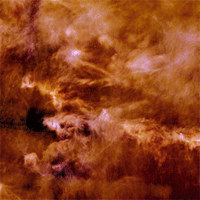
<p></p> <p>The intricate jumble depicted in this image from ESA’s Herschel space observatory shows the distribution of gas and dust in the Taurus Molecular Cloud, a giant stellar nursery about 450

<p><a rel="nofollow" href="http://imgsrc.hubblesite.org/hu/db/images/hs-2015-15-a-web_print.jpg" target="_blank"></a></p> <p>Scientists using NASA’s Hubble Space Telescope have discovered that the immense halo of gas enveloping the Andromeda galaxy, our nearest massive galactic neighbor, is about six times

<p><a href="http://www.nasa.gov/sites/default/files/thumbnails/image/15-077-nustar.jpg" target="_blank"></a></p> <p>Peering into the heart of the Milky Way galaxy, NASA’s Nuclear Spectroscopic Telescope Array (NuSTAR) has spotted a mysterious glow of high-energy X-rays that, according to scientists, could
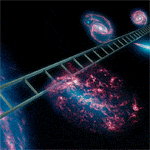
<p><a href="http://hubblesite.org/newscenter/archive/releases/2015/07/image/a/format/web_print/" target="_blank"></a></p> <p>Astronomers at the Space Telescope Science Institute and the Johns Hopkins University, both in Baltimore, Maryland, have created a new master catalog of astronomical objects called the Hubble
<p></p> <p>NASA’s Nuclear Spectroscopic Telescope Array (NuSTAR) and ESA’s (European Space Agency) XMM-Newton telescope are showing that fierce winds from a supermassive black hole blow outward in all directions — a