NGC 1333 Is a Hotbed of Star FormationNGC 1333 Is a Hotbed of Star Formation
<p></p> <p>While fireworks only last a short time here on Earth, a bundle of cosmic sparklers in a nearby cluster of stars will be going off for a very long time.

<p></p> <p>While fireworks only last a short time here on Earth, a bundle of cosmic sparklers in a nearby cluster of stars will be going off for a very long time.

<p style="text-align: center;"></p> <p>Astronomers using ESA’s Herschel space observatory to probe the turbulent beginnings of a Sun-like star have found evidence of mighty stellar winds that could solve a puzzling meteorite
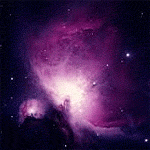
<p style="text-align:center"></p> <p> This new view of the Orion A star-formation cloud from ESA’s Herschel space observatory shows the turbulent region of space that hugs the famous Orion Nebula.</p> <p>The nebula lies
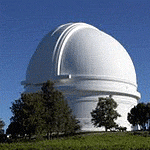
<p style="text-align:center"></p> <p>Thanks to new technology developed in part at the University of Arizona, astronomers can now view objects in the sky at unprecedented sharpness in visible light. Using a telescope
<p>Astronomers using ESA’s Herschel and NASA’s Spitzer space telescopes have detected surprisingly rapid changes in the brightness of embryonic stars within the well-known Orion Nebula.</p> <p style="text-align:center" class=small><br /> This
<p>This is the Orion Nebula, a vast stellar nursery located 1,500 light-years away. We have the Spitzer Space Telescope and its infrared camera to thank for this incredible image.</p> <p style="text-align:center"
AAVSO Alert Notice 427<br /> Observing campaign on BM Ori and the Trapezium region<br /> November 23, 2010<br /> <p></p> <p>The AAVSO requests ground-based observations of the Trapezium region of the Orion Nebula (M42),