ExoMars 2020 Is a Go!ExoMars 2020 Is a Go!
<p></p> <p>The first ExoMars mission arrived at the Red Planet in October and now the second mission has been confirmed to complete its construction for a 2020 launch. </p> <p>ESA and Thales
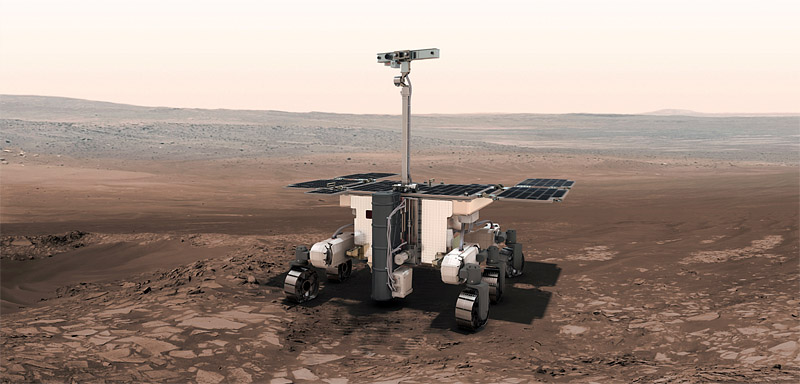
<p></p> <p>The first ExoMars mission arrived at the Red Planet in October and now the second mission has been confirmed to complete its construction for a 2020 launch. </p> <p>ESA and Thales

<p>The ExoMars spacecraft is almost complete. A joint mission between ESA and Roscosmos, it begins with the launch of the ExoMars orbiter in 2016 and carries an aerodynamically designed capsule

<p style="text-align:center"></p> <p>British planetary scientist Professor Colin Pillinger, a former ESA principal investigator, died on May 7th. He suffered a brain haemorrhage at his home in Cambridge and died in hospital.</p> <p>Pillinger,

<p>I remember being glued to the TV just after Christmas in 1977 as Carl Sagan delivered that years’s Royal Institution Christmas Lectures. This was in the days before Video Cassette
<p style="text-align:center"></p> <p>A team of scientists at NASA’s Johnson Space Center in Houston and the Jet Propulsion Laboratory in Pasadena, Calif., has found evidence of past water movement throughout a Martian

<p style="text-align:center"><a href="http://www.nasa.gov/jpl/msl/mars-rover-curiosity-pia17603.html" target="_blank"></a></p> <p>NASA’s Curiosity rover is providing vital insight about Mars’ past and current environments that will aid plans for future robotic and human missions.</p> <p>In a little more than

<p>In this 6th session of the internet-based live lectures between Universities and Institutes, Dr Jorge Vago (ESA) discusses missions to Mars and in particular the European mission ExoMars. </p> <p></p> <p>ExoMars’s scientific
<p>NASA’s most advanced planetary rover is on a precise course for an early August landing beside a Martian mountain to begin two years of unprecedented scientific detective work. However, getting
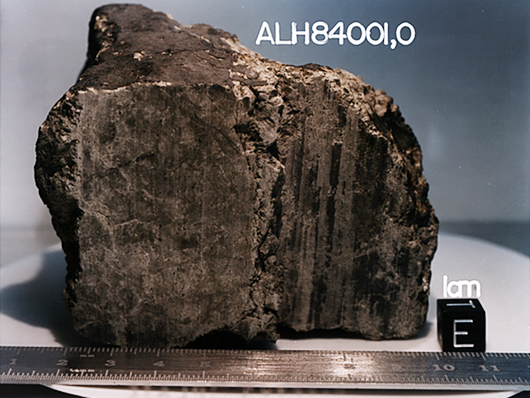
<p>NASA-funded research on Mars meteorites that landed on Earth shows strong evidence that very large molecules containing carbon, which is a key ingredient for the building blocks of life, can
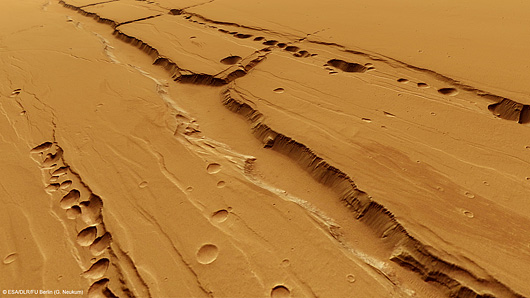
<p>The latest images released from ESA’s Mars Express reveal a series of ‘pit-chains’ on the flanks of one of the largest volcanoes in the Solar System. Depending on their origin,