Hitchhiking Between Comets and AsteroidsHitchhiking Between Comets and Asteroids
<p></p> <p>Catching a ride from one solar system body to another isn’t easy. You have to figure out how to land your spacecraft safely and then get it on its way

<p></p> <p>Catching a ride from one solar system body to another isn’t easy. You have to figure out how to land your spacecraft safely and then get it on its way

<p><a href="http://www.nasa.gov/sites/default/files/thumbnails/image/tn-p_lorri_fullframe_color.png" target="_blank"></a></p> <p>NASA’s New Horizons spacecraft is at Pluto.</p> <p>After a decade-long journey through our solar system, New Horizons made its closest approach to Pluto Tuesday, about 7,750 miles above the
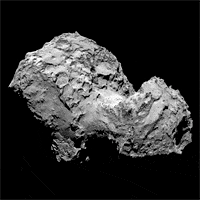
<p><a href="http://www.esa.int/var/esa/storage/images/esa_multimedia/images/2015/03/first_detection_of_molecular_nitrogen_at_a_comet/15318003-1-eng-GB/First_detection_of_molecular_nitrogen_at_a_comet.jpg" target="_blank" rel="nofollow"></a></p> <p>ESA’s Rosetta spacecraft has made the first measurement of molecular nitrogen at a comet, providing clues about the temperature environment in which Comet 67P/Churyumov–Gerasimenko formed.</p> <p>Rosetta arrived last

<p></p> <p>A NASA-sponsored website designed to crowdsource analysis of data from the agency’s Wide-field Infrared Survey Explorer (WISE) mission has reached an impressive milestone. In less than a year, citizen scientists
<p></p> <p>Where did our planet get its oceans? Among planetary scientists, this is one of the most important and perplexing questions about the origins of Earth.</p> <p>One popular theory holds that water

<p style="text-align: center;"></p> <p>NASA’s Pluto-bound New Horizons spacecraft has traversed the orbit of Neptune. This is its last major crossing en route to becoming the first probe to make a close

<p style="text-align:center"></p> <p>NASA is inviting the public to help astronomers discover embryonic planetary systems hidden among data from the agency’s Wide-field Infrared Survey Explorer (WISE) mission through a new website, DiskDetective.org.</p> <p>Disk

<p>The International Astronomical Union (IAU) — the official body that governs the designations of all celestial bodies — in their capacity of purveyors of all things “official” has deemed attempts
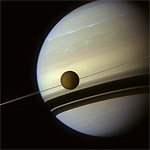
<br /> The Cassini spacecraft observes three of Saturn’s moons set against the darkened night side of the planet. Saturn is present on the left this image but is too dark
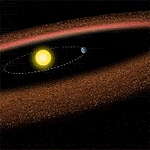
<p style="text-align:center" class="small"><br /> This artist’s concept illustrates an asteroid belt around the bright star Vega. Evidence for this warm ring of debris was found using NASA’s Spitzer Space Telescope, and