Dione and SaturnDione and Saturn
<p></p> <p>Saturn has many, varied moons – over 60 have been discovered so far. One of the larger ones, Dione, is shown here in this image from the Cassini orbiter, pictured

<p></p> <p>Saturn has many, varied moons – over 60 have been discovered so far. One of the larger ones, Dione, is shown here in this image from the Cassini orbiter, pictured

<p style="text-align: center;"><a href="http://imgsrc.hubblesite.org/hu/db/images/hs-2014-45-a-web_print.jpg" target="_blank"></a></p> <p>This composite Hubble Space Telescope image (click image for larger view) captures the positions of Comet Siding Spring and Mars in a never-before-seen close passage of
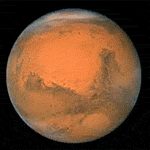
<p style="text-align:center"></p> <p>A team of scientists at NASA’s Johnson Space Center in Houston and the Jet Propulsion Laboratory in Pasadena, Calif., has found evidence of past water movement throughout a Martian
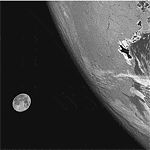
<p style="text-align:center"></p> <p>When NASA’s Juno spacecraft flew past Earth on Oct. 9, 2013, it received a boost in speed of more than 8,800 mph (about 7.3 kilometer per second), which set
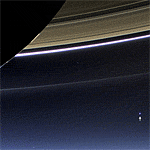
<p style="text-align:center"></p> <p>Color and black-and-white images of Earth taken by two NASA interplanetary spacecraft on July 19 show our planet and its moon as bright beacons from millions of miles away
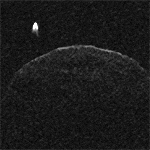
<p>Scientists working with NASA’s 230-foot-wide (70-meter) Deep Space Network antenna at Goldstone, Calif., have released a new and improved movie clip of near-Earth asteroid 1998 QE2 and its moon. The

<p style="text=align:center"><br /> <em>The first radar images of asteroid 1998 QE2 were obtained when the asteroid was about 3.75 million miles (6 million kilometers) from Earth. The radar collage covers a

<p style="text-align:center"></p> <p>On May 31, 2013, asteroid 1998 QE2 will sail serenely past Earth, getting no closer than about 3.6 million miles (5.8 million kilometers), or about 15 times the distance

<p>Research by NASA and international scientists concludes giant asteroids, similar or larger than the one believed to have killed the dinosaurs, hit Earth billions of years ago with more frequency
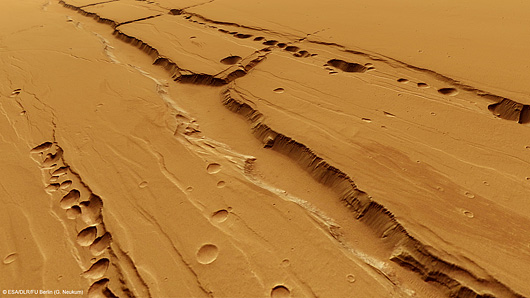
<p>The latest images released from ESA’s Mars Express reveal a series of ‘pit-chains’ on the flanks of one of the largest volcanoes in the Solar System. Depending on their origin,