Dione and SaturnDione and Saturn
<p></p> <p>Saturn has many, varied moons – over 60 have been discovered so far. One of the larger ones, Dione, is shown here in this image from the Cassini orbiter, pictured

<p></p> <p>Saturn has many, varied moons – over 60 have been discovered so far. One of the larger ones, Dione, is shown here in this image from the Cassini orbiter, pictured
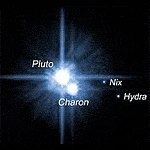
<p></p> <p>What’s icy, has “wobbly” potato-shaped moons, and is the world’s best-known dwarf planet? The answer is Pluto, and NASA’s New Horizons is speeding towards the edge of our solar system
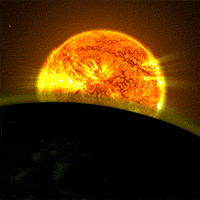
<p style="text-align:center"></p> <p>Using the powerful eye of NASA’s Hubble Space Telescope, two teams of scientists have found faint signatures of water in the atmospheres of five distant planets.</p> <p>The presence of atmospheric

<p>NASA’s Spitzer Space Telescope has detected light emanating from a “super-Earth” planet beyond our solar system for the first time. While the planet is not habitable, the detection is a
<table cellspacing="0" cellpadding="0" width="215" align="left"> <tr> <td> <a rel="nofollow" href="http://www.esa.int/SPECIALS/Gagarin/SEMYN76UPLG_1.html" target="_blank"></a> </td> <td></td> </tr> <tr> <td> <p class="small" style="text-align: center;">Yuri’s night connected people throughout the world </p></td> <td></td> </tr> </table> <p>Space is an inspirational subject and human spaceflight in particular has motivated
<p>Astronomers have come up with a new way of identifying close, faint stars with NASA’s Galaxy Evolution Explorer satellite. The technique should help in the hunt for planets