Dione and SaturnDione and Saturn
<p></p> <p>Saturn has many, varied moons – over 60 have been discovered so far. One of the larger ones, Dione, is shown here in this image from the Cassini orbiter, pictured

<p></p> <p>Saturn has many, varied moons – over 60 have been discovered so far. One of the larger ones, Dione, is shown here in this image from the Cassini orbiter, pictured

<p></p> <p>New research using data from NASA’s Cassini mission suggests most of the eruptions from Saturn’s moon Enceladus might be diffuse curtains rather than discrete jets. Many features that appear to
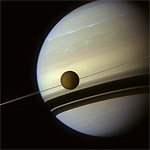
<p style="text-align: center;"></p> <p>Earth is the only planet in our Solar System to have a single solitary moon. While others, such as Mercury and Venus, have none, the gas giants have
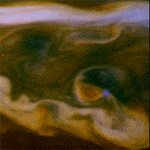
<p style="text-align: center;"></p> <p>Like a swirl from a paintbrush being dipped in water, this image from the Cassini orbiter shows the progress of a massive storm on Saturn. The storm first

<p style="text-align:center" class="small"></p> <p>NASA’s Hubble Space Telescope has observed water vapor above the frigid south polar region of Jupiter’s moon Europa, providing the first strong evidence of water plumes erupting off

<p style="text-align: center;"><a href="http://photojournal.jpl.nasa.gov/figures/PIA17470_fig1.jpg" target="_blank" rel="nofollow"></a></p> <p>With the sun now shining down over the north pole of Saturn’s moon Titan, a little luck with the weather, and trajectories that put the
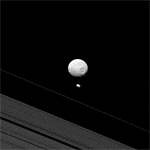
<p style="text-align:center"></p> <p>The Saturn moons Mimas and Pandora remind us of how different they are when they appear together, as in this image taken by NASA’s Cassini spacecraft. Pandora’s small size
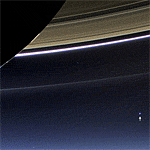
<p style="text-align:center"></p> <p>Color and black-and-white images of Earth taken by two NASA interplanetary spacecraft on July 19 show our planet and its moon as bright beacons from millions of miles away
<p style="text-align: center;"><br /> <em>The Cassini spacecraft looks down, almost directly at the north pole of Dione. The feature just left of the terminator at bottom is Janiculum Dorsa, a long,

<p style="text-align:center" class="small"></p> <p>NASA’s Cassini spacecraft has provided scientists the first close-up, visible-light views of a behemoth hurricane swirling around Saturn’s north pole.</p> <p>In high-resolution pictures and video, scientists see the hurricane’s