As Earth’s magnetic field reverberates from the impact of one Coronal Mass Ejection (CME) on March 8th, a second CME is on the way.

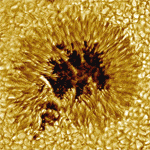
Big sunspot AR1429 unleashed an M6-class solar flare yesterday (March 9th), and the eruption hurled a cloud of plasma almost directly toward Earth.

Forecasters say the CME could reach our planet during the late hours of …

Read the rest of this article

Big sunspot AR1429 has unleashed another major flare–an X5-class eruption on March 7th at 00:28 UT.

As a result of the blast, a radiation storm is underway and a CME will likely hit Earth’s magnetic field in a day or so.

Geomagnetic storms are already in progress at high latitudes due to earlier eruptions from the active sunspot. Last night, …

Read the rest of this article

Big sunspot AR1429, which emerged over the weekend, is crackling with strong flares.

This morning the active region produced an X1-class eruption and a bright coronal mass ejection (CME). This is the strongest so far, occuring on March 5th at 0413 UT.

The CME appears set to deliver a glancing blow to Earth’s magnetic field in the days ahead, possibly …

Read the rest of this article

Earth’s magnetic field reverberated from a Coronal Mass Ejection (CME) impact during the early hours of Jan. 22nd. The hit compressed Earth’s magnetic field, briefly exposing some geosynchronous satellites to solar wind plasma, and disturbed the ionization structure of Earth’s upper atmosphere.

As night fell on Jan. 22nd, Arctic sky watchers reported bright auroras in response to a polar geomagnetic …

Read the rest of this article

Active sunspot 1401 erupted yesterday, Jan. 19th, for more than an hour around 16:00 UT.

The long-duration blast produced an M3-class solar flare and a Coronal Mass Ejection that appears to be heading toward Earth.

Forecasters say strong geomagnetic storms are possible when the cloud arrives during the late hours of Jan. 21st. High-latitude (and possibly middle-latitude) sky watchers should …

Read the rest of this article

A new video from NASA’s Solar Dynamics Observatory shows huge blasts of plasma, called solar prominences, curling around the sun’s tumultuous magnetic field. The remarkable activity was captured Nov. 14 to 15 using a wavelength of extreme ultraviolet light. Never look at the Sun directly yourself – it can lead to blindness!


The Camtasia Studio video content presented here requires …

Read the rest of this article

A coronal mass ejection that swept past Mercury on Nov. 13th will likely hit Venus later today. Because Venus has no global magnetic field to protect it, the impact could erode material directly from the top of the planet’s atmosphere. It’s okay; Venus has atmosphere to spare. Analysts at the Goddard Space Weather Lab calculated the path of the CME, …

Read the rest of this article

NASA’s Solar Dynamics Observatory has spotted one of the largest new sunspots to appear on the surface of the sun in years. It is nearly 25,000 miles wide, or more than three times larger than the Earth. The enormous sunspot was seen rotating over the sun’s northeastern limb on Nov. 3.

Any backyard astronomers with solar telescopes should be able …

Read the rest of this article

Imagine forecasting a hurricane in Miami weeks before the storm was even a swirl of clouds off the coast of Africa or predicting a tornado in Kansas from the flutter of a butterfly’s wing in Texas. These are the kind of forecasts meteorologists can only dream about.

Could the dream come true? A new study by Stanford researchers suggests that …

Read the rest of this article

For the first time, a spacecraft far from Earth has turned and watched a solar storm engulf our planet. The movie, released today during a NASA press conference, has galvanized solar physicists, who say it could lead to important advances in space weather forecasting.

“The movie sent chills down my spine,” says Craig DeForest of the Southwest Research Institute in …

Read the rest of this article