A coronal mass ejection that swept past Mercury on Nov. 13th will likely hit Venus later today. Because Venus has no global magnetic field to protect it, the impact could erode material directly from the top of the planet’s atmosphere. It’s okay; Venus has atmosphere to spare. Analysts at the Goddard Space Weather Lab calculated the path of the CME, which left the sun on Nov. 12th.
There haven’t been any strong solar flares in days. Nevertheless, some impressive activity is underway on the sun. For one thing, an enormous wall of plasma is towering over the sun’s southeastern horizon. Stephen Ramsden of Atlanta, Georgia, took this picture on Nov. 11th:

This gigantic prominence graced the Southeastern rim Nov. 12 in its relentless march towards the Earth facing side of the Sun. Solar forums all over the world were buzzing with Sun-stronomers proclaiming that it was the biggest prominence that many of them had ever witnessed. This shot was taken at the Georgia Regional Astronomers Meeting at Agnes Scott College in Atlanta GA with a Lunt LS100 and an Imaging Source DMK21. The Earth was added for scale.
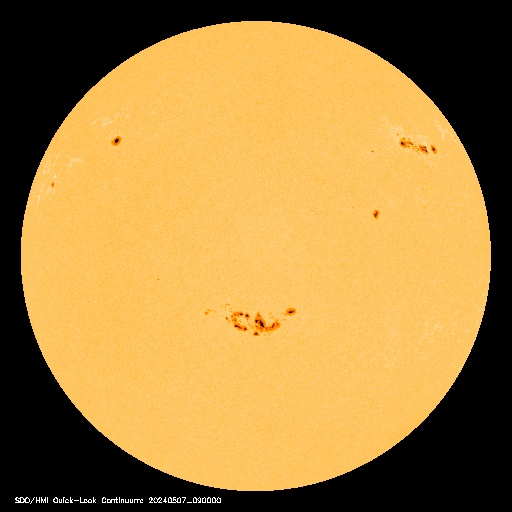
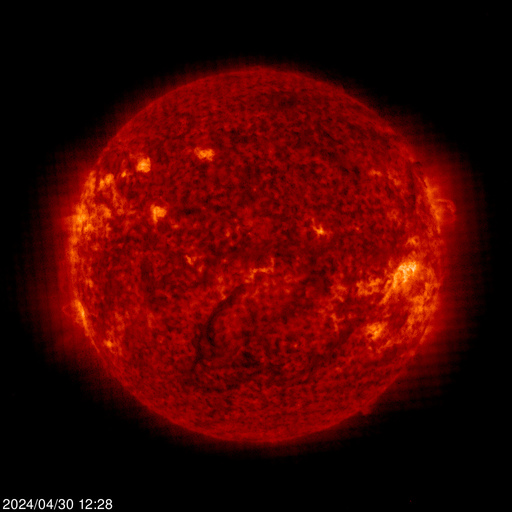
The sun is putting on one of its best displays of the new solar cycle – not with sunspots and flares, but rather with towering walls of plasma and filaments of magnetism. One dark filament is stretching more than a million kilometers across the face of the sun, about three times the distance between Earth and the Moon.
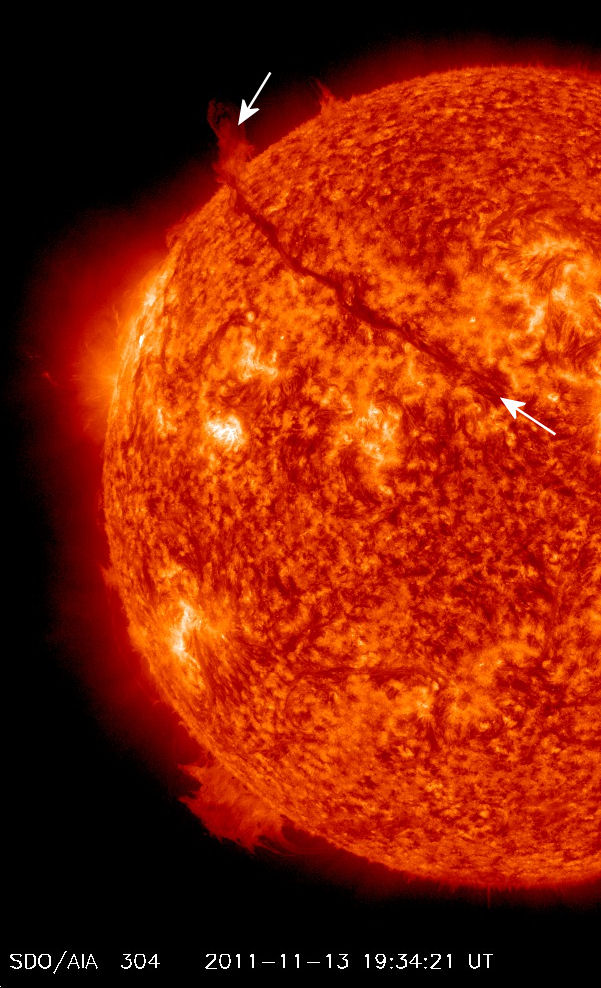
Image: SDO
If the filament becomes unstable, as solar filaments are prone to do, it could collapse and hit the stellar surface below, triggering a Hyder flare. No one can say if the eruption of such a sprawling structure would be Earth directed.
“I cant help but wonder what could possibly come next since we are still over a year away from the forecasted Solar Maximum,” adds Stephen Ramsden. “There’s never been a better time to own a solar telescope than now!”
Via spaceweather.com
Filed under: The Sun