People from around the world are converging on the coast of northeast Australia. The attraction isn’t the Great Barrier Reef, just offshore, or the surrounding rain forests full of wildlife and exotic plants. They’re going to see a total eclipse of the sun.


Solar eclipses aren’t only pretty, they’re also scientifically valuable.

On the morning of Nov. 14th (Australia time), …

Read the rest of this article

The Sun

New sunspot AR1532 is crackling with M-class solar flares, including a brief but intense M6-flare on July 28th. A coronal mass ejection (CME) produced by Saturday’s M6-class flare is heading toward Earth. According to analysts at the Goddard Space Weather Lab, the cloud could deliver a glancing blow to our planet’s magnetic field on July 31st around 1500 UT (+/- …

Read the rest of this article

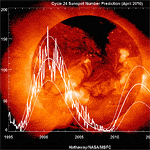
Forecasters say Solar Max is due in the year 2013. When it arrives, the peak of 11-year sunspot cycle will bring more solar flares, more coronal mass ejections, more geomagnetic storms and more auroras than we have experienced in quite some time.


Solar maximum is still a year away. This month sky watchers got a taste of things to come …

Read the rest of this article

The Sun

A telescope launched July 11 aboard a NASA sounding rocket has captured the highest-resolution images ever taken of the sun’s million-degree atmosphere called the corona. The clarity of the images can help scientists better understand the behavior of the solar atmosphere and its impacts on Earth’s space environment.


A telescope launched July 11 aboard a NASA sounding rocket has captured …

Read the rest of this article

A favorite theme of science fiction is “the portal”–an extraordinary opening in space or time that connects travelers to distant realms. A good portal is a shortcut, a guide, a door into the unknown. If only they actually existed….

It turns out that they do, sort of, and a NASA-funded researcher at the University of Iowa has figured out how …

Read the rest of this article

The Sun

During a powerful solar blast on March 7, NASA’s Fermi Gamma-ray Space Telescope detected the highest-energy light ever associated with an eruption on the sun. The discovery heralds Fermi’s new role as a solar observatory, a powerful new tool for understanding solar outbursts during the sun’s maximum period of activity.


During a powerful solar blast in March, NASA’s Fermi Gamma-ray …

Read the rest of this article

The Sun

Huge sunspot AR1476 is crackling with M-class solar flares and appears to be on the verge of producing something even stronger.

The sunspot’s ‘beta-gamma-delta’ magnetic field harbors energy for X-class flares, the most powerful kind.

Radio operators are recording strong bursts of shortwave static from the sunspot as it turns toward Earth. Visit http://spaceweather.com for sample recordings and forecasts.

Solar …

Read the rest of this article

Last month, when the sun unleashed the most intense radiation storm since 2003, peppering satellites with charged particles and igniting strong auroras around both poles, a group of high school students in Bishop, California, knew just what to do. They launched a rubber chicken.

Camilla at ~124,800 feet on March 3, 2012.

The students inflated a helium balloon and used …

Read the rest of this article

On April 16th around 17:45 UT, magnetic fields curling over the sun’s northeastern limb rose up and erupted, producing one of the most visually-spectacular explosions in years.

The event, which also produced an M1.7-class solar flare and a coronal mass ejection, was not Earth-directed. Nevertheless, it confirms suspicions that a significant active region is rotating onto the Earth-side of the …

Read the rest of this article

Sunspot AR1429 unleashed another strong flare (category M7.9) on March 13th. The explosion produced a significant coronal mass ejection (CME), which forecasters say should reach Earth today, March 15th, at 06:20 UT (+/- 7 hours), possibly triggering minor to moderate geomagnetic storms.

A bright comet related to sungrazing Comet Lovejoy dove towards the sun earlier this week. The orbiting Solar …

Read the rest of this article