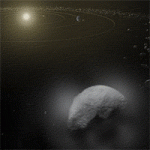
ESA’s Herschel space observatory has discovered water vapour around Ceres, the first unambiguous detection of water vapour around an object in the asteroid belt.

With a diameter of 950 km, Ceres is the largest object in the asteroid belt, which lies between the orbits of Mars and Jupiter. But unlike most asteroids, Ceres is almost spherical and belongs to the …

Read the rest of this article

This animation shows the timeline of over 37,000 scientific observations made by ESA’s Herschel space observatory throughout its entire mission, condensed into less than a minute.

The animation was prepared by Pedro Gómez-Alvarez in the Herschel Science Centre Community Support Group and presented by Herschel’s Project Scientist Göran Pilbratt during the opening session of The Universe Explored by Herschel symposium …

Read the rest of this article

 
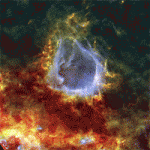
Nestled within the shell around this large bubble is an embryonic star that is already a hefty eight times more massive than our Sun.

This image, by ESA’s Herschel space observatory, was originally presented in the first announcement of scientific results  from the mission in May 2010.

This week Herschel scientists will meet again at ESA’s ESTEC establishment in the …

Read the rest of this article

Using a telescope in Antarctica and ESA’s Herschel space observatory, astronomers have made the first detection of a subtle twist in the relic radiation from the Big Bang, paving the way towards revealing the first moments of the Universe’s existence.

The elusive signal was found in the way the first light in the Universe has been deflected during its journey …

Read the rest of this article

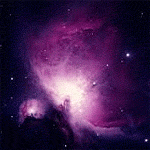
This new view of the Orion A star-formation cloud from ESA’s Herschel space observatory shows the turbulent region of space that hugs the famous Orion Nebula.

The nebula lies about 1500 light years from Earth within the ‘sword of Orion’ – below the three main stars that form the belt of the Orion constellation.

In this view, the nebula corresponds …

Read the rest of this article

The tiny dot against the streaking star field in the image below is one of the last views that ground-based observers will see of ESA’s iconic Herschel space observatory.


The Herschel space observatory is shown here in monochrome and negative against a backdrop of stars, the latter streaked by the telescope tracking the motion of the observatory as it drifts …

Read the rest of this article

In 1948, astronomer Fritz Zwicky, the esteemed co-discoverer of dark matter, speculated that “fusion jets” could be used by a future civilization to navigate our sun and solar system planets through the galaxy. He suggested that pellets of fuel could be fired into the sun to produce explosions that would push the sun along like firecrackers exploding in a …

Read the rest of this article

With the exhaustion of its helium coolant, Herschel’s science mission ended on 29 April. But the stalwart satellite continued providing value to the end, serving as an orbiting testbed for control techniques that can’t normally be tested in flight.


Martin Kessler, Head of ESA’s Science Operations Department, sends the final command to Herschel at 12:25 GMT (14:25 CEST), 17 June …

Read the rest of this article

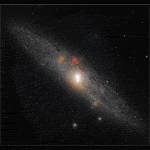
Nearly a decade ago, NASA’s Chandra X-ray Observatory caught signs of what appeared to be a black hole snacking on gas at the middle of the nearby Sculptor galaxy. Now, NASA’s Nuclear Spectroscopic Telescope Array (NuSTAR), which sees higher-energy X-ray light, has taken a peek and found the black hole asleep.


The Sculptor galaxy is seen in a new light, …

Read the rest of this article

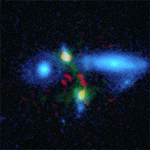
A massive and rare merging of two galaxies has been spotted in images taken by the Herschel space observatory, a European Space Agency mission with important NASA participation.

Follow-up studies by several telescopes on the ground and in space, including NASA’s Hubble Space Telescope and Spitzer Space Telescope, tell a tale of two faraway galaxies intertwined and furiously making stars. …

Read the rest of this article