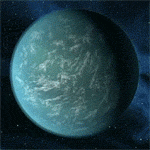
There are a ton of exceedingly odd collegiate classes floating around out there. Now Edinburgh University is joining the fine tradition of off-beat classes, and they’re doing it online and for free.

This course, called ”Astrobiology and the Search for Extraterrestrial Life,” will last five weeks, and is part of the university’s set of free online courses. It’s pretty cool, …

Read the rest of this article

Giant bubbles, towering pillars and cascading clouds of dust and gas fill the star-forming nursery of the Carina Nebula seen here in a stunning new view from Herschel to launch ESA Space Science’s image of the week feature.


The Carina Nebula, by ESA’s Herschel space observatory. The image (enlarged view) shows the effects of massive star formation – …

Read the rest of this article

The first instrument to be completed for the James Webb Space Telescope, MIRI, was handed over by the European consortium that built it to ESA at a ceremony held in London today, and will now be delivered to NASA aiming for launch in 2018.


MIRI, the Mid Infrared Instrument, being prepared for vibration testing at the Science and Technology Facilities …

Read the rest of this article
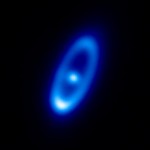
ESA’s Herschel Space Observatory has studied the dusty belt around the nearby star Fomalhaut. The dust appears to be coming from collisions that destroy up to thousands of icy comets every day.


Herschel’s image of Fomalhaut

Fomalhaut is a young star, just a few hundred million years old, and twice as massive as the Sun. Its dust belt was discovered …

Read the rest of this article
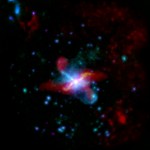
Two of ESA’s space observatories have combined to create a multi-wavelength view of violent events taking place within the giant galaxy of Centaurus A. The new observations strengthen the view that it may have been created by the cataclysmic collision of two older galaxies.


The peculiar galaxy Centaurus A in the far-infrared and X-rays. Inner structural features seen in this …

Read the rest of this article
Astronomers using ESA’s Herschel and NASA’s Spitzer space telescopes have detected surprisingly rapid changes in the brightness of embryonic stars within the well-known Orion Nebula.


This new view of the Orion Nebula shows embryonic stars within extensive gas and dust clouds. Combining far-infrared observations from the Herschel Space Observatory and mid-infrared observations from NASA’s Spitzer Space Telescope, the image shows …

Read the rest of this article
In 1995, the Hubble Space Telescope’s ‘Pillars of Creation’ image of the Eagle Nebula became one of the most iconic images of the 20th century. Now, two of ESA’s orbiting observatories have shed new light on this enigmatic star-forming region.


Combining almost opposite ends of the electromagnetic spectrum, this composite of the Herschel in far-infrared and XMM-Newton’s X-ray images shows …

Read the rest of this article

ESA’s Herschel space observatory has found evidence of water vapour emanating from ice on dust grains in the disc around a young star, revealing a hidden ice reservoir the size of thousands of oceans.


This image shows an artist’s impression of the icy protoplanetary disc around the young star TW Hydrae (upper panel) and the spectrum of the disc as …

Read the rest of this article

NASA’s James Webb Space Telescope has reached a major milestone in its development. The mirrors that will fly aboard the telescope have completed the coating process at Quantum Coating Inc. in Moorestown, N.J.

The telescope’s mirrors have been coated with a microscopically thin layer of gold, selected for its ability to properly reflect infrared light from the mirrors into the …

Read the rest of this article

ESA’s Herschel space observatory has shown that water expelled from the moon Enceladus forms a giant torus of water vapour around Saturn. The discovery solves a 14-year mystery by identifying the source of the water in Saturn’s upper atmosphere.


At least four distinct plumes of water ice spew out from the south polar region of Saturn’s moon Enceladus. Light reflected …

Read the rest of this article