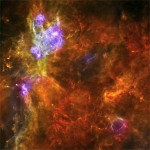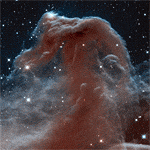
New views of the Horsehead Nebula and its turbulent environment have been unveiled by ESA’s Herschel space observatory and the NASA/ESA Hubble space telescope.


Stunning new view from ESA’s Herschel space observatory of the iconic Horsehead Nebula in the context of its surroundings. The image is a composite of the wavelengths of 70 microns (blue), 160 microns (green) and 250 …
Read the rest of this article

ESA’s Herschel space observatory has discovered an extremely distant galaxy making stars more than 2000 times faster than our own Milky Way. Seen at a time when the Universe was less than a billion years old, its mere existence challenges our theories of galaxy evolution.


Artist’s impression of starburst galaxy HFLS3. The galaxy appears as little more than a faint, …

Read the rest of this article

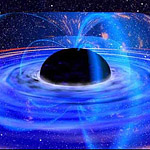
Astronomers have watched as a black hole woke up from a decades-long slumber to feed on a low-mass object – either a brown dwarf or a giant planet – that strayed too close. A similar feeding event, albeit on a gas cloud, will soon happen at the black hole at the centre of our own Milky Way Galaxy.

Loading…


jwplayer("pi_player").setup({ …

Read the rest of this article

This three-colour image of the W3 giant molecular cloud combines Herschel bands at 70 μm (blue), 160 μm (green) and 250 μm (red). The image spans about 2 x 2 degrees. North is up and east is to the left. W3 is an enormous stellar nursery about 6200 light-years away in the Perseus Arm, one of the Milky Way galaxy’s…

Read the rest of this article

Astronomers have found some of the youngest stars ever seen, thanks to the Herschel space observatory, a European Space Agency mission with important NASA contributions.

Observations from NASA’s Spitzer Space Telescope and the Atacama Pathfinder Experiment (APEX) telescope in Chile, a collaboration involving the Max Planck Institute for Radio Astronomy in Germany, the Onsala Space Observatory in Sweden, and the …

Read the rest of this article

The Sun

ESA’s Herschel space observatory has detected a cool layer in the atmosphere of Alpha Centauri A, the first time this has been seen in a star beyond our own Sun. The finding is not only important for understanding the Sun’s activity, but could also help in the quest to discover proto-planetary systems around other stars.


One of the great curiosities …

Read the rest of this article

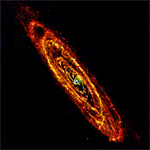
In this new view of the Andromeda galaxy from ESA’s Herschel space observatory, cool lanes of forming stars are revealed in the finest detail yet.

Andromeda, also known as M31, is the nearest major galaxy to our own Milky Way at a distance of 2.5 million light-years, making it an ideal natural laboratory to study star formation and galaxy evolution.…

Read the rest of this article


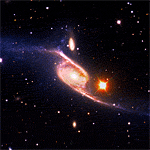
This composite of the giant barred spiral galaxy NGC 6872 combines visible light images from the European Southern Observatory’s Very Large Telescope with far-ultraviolet (1,528 angstroms) data from NASA’s GALEX and 3.6-micron infrared data acquired by NASA’s Spitzer Space Telescope. A previously unsuspected tidal dwarf galaxy candidate (circled) appears only in the ultraviolet, indicating the presence of many hot young …

Read the rest of this article


ESA’s Herschel Space Observatory captured asteroid Apophis in its field of view during the approach to Earth on 5/6 January 2013. This image shows the asteroid in Herschel’s three PACS wavelengths: 70, 100 and 160 microns, respectively. Its closest pass, on 9 January 2013, brings it to 14.45 million km from Earth, 35–40 times that of the distance of the …

Read the rest of this article


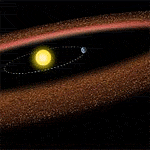
This artist’s concept illustrates an asteroid belt around the bright star Vega. Evidence for this warm ring of debris was found using NASA’s Spitzer Space Telescope, and the European Space Agency’s Herschel Space Observatory, in which NASA plays an important role. Image credit: NASA/JPL-Caltech

Astronomers have discovered what appears to be a large asteroid belt around the star Vega, the …

Read the rest of this article