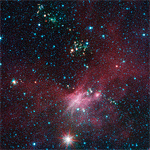
Dozens of newborn stars sprouting jets from their dusty cocoons have been spotted in images from NASA’s Spitzer Space Telescope.

New views from NASA’s Spitzer Space Telescope show blooming stars in our Milky Way galaxy’s more barren territories, far from its crowded core.

The images are part of the Galactic Legacy Infrared Mid-Plane Survey Extraordinaire (Glimpse 360) project, which is …

Read the rest of this article
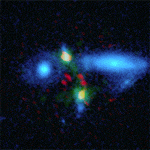
A massive and rare merging of two galaxies has been spotted in images taken by the Herschel space observatory, a European Space Agency mission with important NASA participation.

Follow-up studies by several telescopes on the ground and in space, including NASA’s Hubble Space Telescope and Spitzer Space Telescope, tell a tale of two faraway galaxies intertwined and furiously making stars. …

Read the rest of this article

Applying a maxim from computer science to biology raises the intriguing possibility that life existed before Earth did and may have originated outside our solar system, scientists say.


In the science fiction movie Prometheus (2012), the building blocks of life were provided by a proto-human species from another planet.
Image credit: Prometheus (2012) from Twentieth Century Fox

Moore’s Law is …

Read the rest of this article
ESA’s Herschel space observatory has discovered an extremely distant galaxy making stars more than 2000 times faster than our own Milky Way. Seen at a time when the Universe was less than a billion years old, its mere existence challenges our theories of galaxy evolution.


Artist’s impression of starburst galaxy HFLS3. The galaxy appears as little more than a faint, …

Read the rest of this article

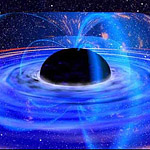
Astronomers have watched as a black hole woke up from a decades-long slumber to feed on a low-mass object – either a brown dwarf or a giant planet – that strayed too close. A similar feeding event, albeit on a gas cloud, will soon happen at the black hole at the centre of our own Milky Way Galaxy.

Loading…


jwplayer("pi_player").setup({ …

Read the rest of this article

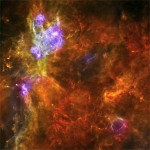
This three-colour image of the W3 giant molecular cloud combines Herschel bands at 70 μm (blue), 160 μm (green) and 250 μm (red). The image spans about 2 x 2 degrees. North is up and east is to the left. W3 is an enormous stellar nursery about 6200 light-years away in the Perseus Arm, one of the Milky Way galaxy’s…
Read the rest of this article

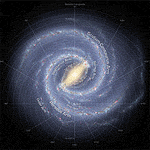
Peering deep into the vast stellar halo that envelops our Milky Way galaxy, astronomers using NASA’s Hubble Space Telescope have uncovered tantalizing evidence for the possible existence of a shell of stars that are a relic of cannibalism by our Milky Way.


This illustration shows the disk of our Milky Way galaxy, surrounded by a faint, extended halo of old …

Read the rest of this article

NASA’s Deep Impact spacecraft has acquired its first images of comet C/2012 S1 (ISON). The images were taken by the spacecraft’s Medium-Resolution Imager over a 36-hour period on Jan. 17 and 18, 2013, from a distance of 493 million miles (793 million kilometers). Many scientists anticipate a bright future for comet ISON; the spaceborne conglomeration of dust and ice may …

Read the rest of this article

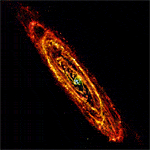
In this new view of the Andromeda galaxy from ESA’s Herschel space observatory, cool lanes of forming stars are revealed in the finest detail yet.

Andromeda, also known as M31, is the nearest major galaxy to our own Milky Way at a distance of 2.5 million light-years, making it an ideal natural laboratory to study star formation and galaxy evolution.…

Read the rest of this article


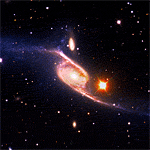
This composite of the giant barred spiral galaxy NGC 6872 combines visible light images from the European Southern Observatory’s Very Large Telescope with far-ultraviolet (1,528 angstroms) data from NASA’s GALEX and 3.6-micron infrared data acquired by NASA’s Spitzer Space Telescope. A previously unsuspected tidal dwarf galaxy candidate (circled) appears only in the ultraviolet, indicating the presence of many hot young …

Read the rest of this article