Students from across Europe have been selected as the winners of the ESA’s ‘Explore the high-energy Universe’ competition.

Secondary school students were invited to choose from four projects relating to ESA’s Integral gamma-ray observatory in which they were challenged to Observe, Research, Design, or Build.


ESA’s Integral gamma-ray observatory is able to detect gamma-ray bursts, the most energetic phenomena in …
Read the rest of this article

The Herschel Space Observatory has shown galaxies with the most powerful, active black holes at their cores produce fewer stars than galaxies with less active black holes. The results are the first to demonstrate black holes suppressed galactic star formation when the universe was less than half its current age.


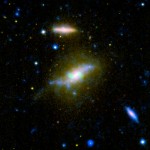
This artistically modified image of the local galaxy Arp 220, …

Read the rest of this article

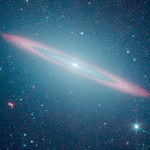
While some galaxies are rotund and others are slender disks like our spiral Milky Way, new observations from NASA’s Spitzer Space Telescope show that the Sombrero galaxy is both. The galaxy, which is a round elliptical galaxy with a thin disk embedded inside, is one of the first known to exhibit characteristics of the two different types. The findings will …

Read the rest of this article

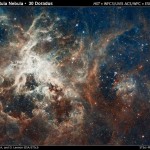
Several million young stars are vying for attention in a new NASA Hubble Space Telescope image of a raucous stellar breeding ground in 30 Doradus, a star-forming complex located in the heart of the Tarantula nebula.


The image comprises one of the largest mosaics ever assembled from Hubble photos and includes observations taken by Hubble’s Wide Field Camera 3 and …

Read the rest of this article

Supernova explosions and the jets of a monstrous black hole are scattering a galaxy’s star-making gas like a cosmic leaf blower, a new study finds. The findings, which relied on ultraviolet observations from NASA’s Galaxy Evolution Explorer and a host of other instruments, fill an important gap in the current understanding of galactic evolution.


Time is running out for the …

Read the rest of this article

ESA’s Planck mission has revealed that our Galaxy contains previously undiscovered islands of cold gas and a mysterious haze of microwaves. These results give scientists new treasure to mine and take them closer to revealing the blueprint of cosmic structure.


This all-sky image shows the distribution of carbon monoxide (CO), a molecule used by astronomers to trace molecular clouds across …

Read the rest of this article

Researchers announced the finding at a press conference on Jan. 31, 2012. It’s based on data from NASA’s IBEX spacecraft, which is able to sample material flowing into the solar system from interstellar space.…

Read the rest of this article

ESA’s Gaia star-mapper has passed a critical test ahead of its launch in 2013: the spacecraft’s sunshield has been deployed for the first time.

Gaia’s sunshield is an essential component of the mission. It keeps Gaia in shadow, maintaining the scientific instruments at a constant temperature of around –110°C.


The Camtasia Studio video content presented here requires a more recent …

Read the rest of this article

For more than four hundred years, astronomers have used telescopes to study the great variety of stars in our galaxy. Millions of distant suns have been catalogued. There are dwarf stars, giant stars, dead stars, exploding stars, binary stars; by now, you might suppose that every kind of star in the Milky Way had been seen.

That’s why a recent …

Read the rest of this article

Two teams of astronomers have discovered the largest and farthest reservoir of water ever detected in the universe. The water, equivalent to 140 trillion times all the water in the world’s ocean, surrounds a huge, feeding black hole, called a quasar, more than 12 billion light-years away.


This artist’s concept illustrates a quasar, or feeding black hole, similar to APM …

Read the rest of this article