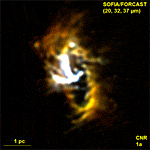
Researchers using the Stratospheric Observatory for Infrared Astronomy (SOFIA) have captured new images of a ring of gas and dust seven light-years in diameter surrounding the supermassive black hole at the center of the Milky Way, and of a neighboring cluster of extremely luminous young stars embedded in dust cocoons.


SOFIA/FORCAST mid-infrared image of the Milky Way galaxy’s nucleus showing …
Read the rest of this article


This new view of spiral galaxy IC 342, also known as Caldwell 5, includes data from NASA’s Nuclear Spectroscopic Telescope Array, or NuSTAR. High-energy X-ray data from NuSTAR have been translated to the color magenta, and superimposed on a visible-light view highlighting the galaxy and its star-studded arms. NuSTAR is the first orbiting telescope to take focused pictures of the …

Read the rest of this article

From over 120 stunning entries to our first Space Science Image of the Week competition, the ESA panel of judges has chosen this beautiful composition of the conjunction of Jupiter and its four large satellites with our own Moon as the winning image of 2012. The image was composed by Antonio Peña from Madrid, Spain, as Jupiter and the Moon

Read the rest of this article

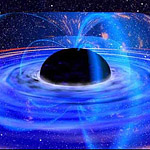
Deep in the heart of the spiral Milky Way galaxy, a hot vortex of matter swirls around a black hole more than a million times as massive as the sun. Many galaxies, perhaps all, contain such a “monster in the middle.” These supermassive black holes sustain themselves by swallowing stars, planets, asteroids, comets and clouds of gas that wander by …

Read the rest of this article

A comprehensive study of hundreds of galaxies observed by the Keck telescopes in Hawaii and NASA’s Hubble Space Telescope has revealed an unexpected pattern of change that extends back 8 billion years, or more than half the age of the universe.


A study of 544 star-forming galaxies observed by the Keck and Hubble telescopes shows that disk galaxies like our …

Read the rest of this article

Astronomers using data from NASA’s Hubble Space Telescope have caught two clusters full of massive stars that may be in the early stages of merging. The clusters are 170,000 light-years away in the Large Magellanic Cloud, a small satellite galaxy to our Milky Way.


This is a Hubble Space Telescope image of a pair of star clusters that are believed …

Read the rest of this article

The NASA/ESA Hubble Space Telescope offers this delightful view of the crowded stellar encampment called Messier 68, a spherical, star-filled region of space known as a globular cluster.


Messier 68 is located about 33 000 light-years from Earth in the constellation Hydra (The Female Water Snake). French astronomer Charles Messier notched the object as the 68th entry in his famous …

Read the rest of this article

Black holes in the early universe needed a few snacks rather than one giant meal to fuel their quasars and help them grow, according to observations from NASA’s Spitzer and Hubble space telescopes.


The galaxies pictured here have so much dust surrounding them that the brilliant light from their quasars cannot be seen in these images NASA’s Hubble Space Telescope. …

Read the rest of this article

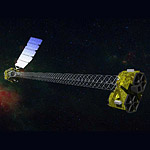
NASA’s Nuclear Spectroscopic Telescope Array (NuSTAR) launched into the morning skies over the central Pacific Ocean at noon EDT (9 a.m. PDT) Wednesday, beginning its mission to unveil secrets of buried black holes and other exotic objects.


NuSTAR has a 30-foot mast that deploys after launch to separate the optics modules (right) from the detectors in the focal plane (left). …

Read the rest of this article

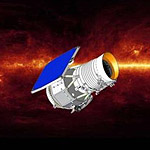
Astronomers are getting to know the neighbors better. Our sun resides within a spiral arm of our Milky Way galaxy about two-thirds of the way out from the center. It lives in a fairly calm, suburb-like area with an average number of stellar residents. Recently, NASA’s Wide-field Infrared Survey Explorer, or WISE, has been turning up a new crowd of …

Read the rest of this article