Chandra X-Ray Observatory

Astronomers using NASA’s Chandra X-ray Observatory have taken a major step in explaining why material around the giant black hole at the center of the Milky Way Galaxy is extraordinarily faint in X-rays. This discovery holds important implications for understanding black holes.

New Chandra images of Sagittarius A* (Sgr A*), which is located about 26,000 light-years from Earth, indicate that …

Read the rest of this article
Ten years after a Delta II rocket launched NASA’s Spitzer Space Telescope, lighting up the night sky over Cape Canaveral, Fla., the fourth of the agency’s four Great Observatories continues to illuminate the dark side of the cosmos with its infrared eyes.

The telescope studied comets and asteroids, counted stars, scrutinized planets and galaxies, and discovered soccer-ball-shaped carbon spheres in …

Read the rest of this article
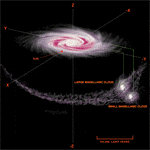
Astronomers using NASA’s Hubble Space Telescope have solved a 40-year mystery on the origin of the Magellanic Stream, a long ribbon of gas stretching nearly halfway around our Milky Way galaxy.

The Large and Small Magellanic Clouds, two dwarf galaxies orbiting the Milky Way, are at the head of the gaseous stream. Since the stream’s discovery by radio telescopes in …

Read the rest of this article

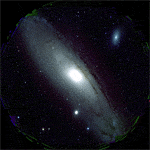
This stunning image of M31 captured by Subaru Telescope‘s Hyper Suprime-Cam (HSC) displays the fruits of international collaboration and technological sophistication aligned with cutting-edge science. The telescope has a large 1.5-degree field of view.

In addition to providing information about a nearby galaxy that resembles our own, this image demonstrates HSC’s capability to fulfill Subaru Telescope’s intention of producing …

Read the rest of this article

Across the world, children fall asleep under the faint light from glow-in-the-dark astronomy stickers. Though undeniably adorable, these ceiling planetariums are too jam-packed to be realistic. You’d never see stars, dozens of spiral galaxies, and comets all at the same time, all shining together from the same patch of sky. Unless, of course, you had Hubble.

On April 30, NASA’s …

Read the rest of this article

Computer simulations by a pair of researchers at the University of Edinburgh predict that a fleet of interstellar probes could explore the entire Milky Way galaxy within a fraction of the present age of Earth. This may seem like a tall order considering that our farthest interstellar spacecraft, Voyager 1, is still less than a light-day from Earth after being …

Read the rest of this article

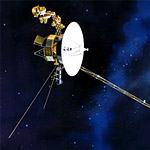
Data from Voyager 1, now more than 11 billion miles (18 billion kilometers) from the sun, suggest the spacecraft is closer to becoming the first human-made object to reach interstellar space.


This artist’s concept shows NASA’s two Voyager spacecraft exploring a turbulent region of space known as the heliosheath, the outer shell of the bubble of charged particles around our …

Read the rest of this article
Chandra X-Ray Observatory

Using data from NASA’s Chandra X-ray Observatory, astronomers have discovered an unprecedented bonanza of black holes in the Andromeda Galaxy, one of the nearest galaxies to the Milky Way.

Using more than 150 Chandra observations, spread over 13 years, researchers identified 26 black hole candidates, the largest number to date, in a galaxy outside our own. Many consider Andromeda to …

Read the rest of this article
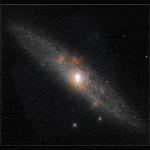
Nearly a decade ago, NASA’s Chandra X-ray Observatory caught signs of what appeared to be a black hole snacking on gas at the middle of the nearby Sculptor galaxy. Now, NASA’s Nuclear Spectroscopic Telescope Array (NuSTAR), which sees higher-energy X-ray light, has taken a peek and found the black hole asleep.


The Sculptor galaxy is seen in a new light, …

Read the rest of this article
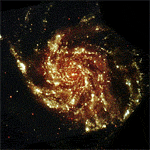
The face-on Pinwheel spiral galaxy seen in the image below is at ultraviolet wavelengths in this image taken by ESA’s XMM-Newton space telescope. Also known as M101, the galaxy lies 21 million light-years away in the constellation Ursa Major. It measures 170 000 light-years across – nearly twice the diameter of our own Milky Way Galaxy – and contains at …

Read the rest of this article