This animation shows the timeline of over 37,000 scientific observations made by ESA’s Herschel space observatory throughout its entire mission, condensed into less than a minute.

The animation was prepared by Pedro Gómez-Alvarez in the Herschel Science Centre Community Support Group and presented by Herschel’s Project Scientist Göran Pilbratt during the opening session of The Universe Explored by Herschel symposium …

Read the rest of this article

This virtual journey shows the different components that make up our home galaxy, the Milky Way, which contains about a hundred billion stars.

It starts at the black hole at the centre of the Milky Way and with the stars that orbit around it, before zooming out through the central Galactic Bulge, which hosts about ten billion stars.

The journey …

Read the rest of this article
NASA’s Great Observatories are teaming up to look deeper into the universe than ever before. With a boost from natural “zoom lenses” found in space, they should be able to uncover galaxies that are as much as 100 times fainter than what the Hubble, Spitzer, and Chandra space telescopes can typically see.

This ambitious collaborative program is called The Frontier …

Read the rest of this article

ESA’s Planck space telescope has been turned off after nearly 4.5 years soaking up the relic radiation from the Big Bang and studying the evolution of stars and galaxies throughout the Universe’s history.

Project scientist Jan Tauber sent the final command to the Planck satellite at 12:10:27 UT on October 23, 2013, marking the end of operations for ESA’s ‘time …

Read the rest of this article

From the tiniest fraction of a second after the Big Bang to the evolution of stars and galaxies over 13.8 billion years, ESA’s Planck space telescope has provided new insight into the history of our Universe. Although science observations are now complete, the legacy of the Planck mission lives on.

Planck was launched in 2009 and spent 4.5 years scanning …

Read the rest of this article

If you’re just starting out on your journey across the celestial sphere, the Levenhuk Strike 90 PLUS telescope will be the perfect instrument for you. It is extremely easy to set up and use, and very simple to calibrate. It’s an ideal guide for touring the mysteries of the universe for children and adults alike, showing you breathtaking views of …

Read the rest of this article

Deep-space missions require precise navigation, in particular when approaching bodies such as Mars, Venus or a comet. How precise?

It’s necessary to pinpoint a spacecraft 100 million kilometres from Earth to within 1 km. To achieve this level of accuracy, ESA experts use ‘quasars’ – the most luminous objects known in the Universe – as beacons in a technique known …

Read the rest of this article
Astronomers using NASA’s Hubble Space Telescope and Chandra X-ray Observatory and telescopes on the ground may have found the most crowded galaxy in our part of the universe.

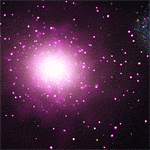
The ultra-compact dwarf galaxy, known as M60-UCD1, is packed with an extraordinary number of stars and may be the densest galaxy near Earth. It is providing astronomers with clues to its intriguing …

Read the rest of this article
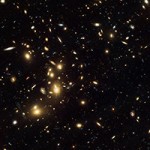
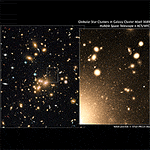
NASA’s Hubble Space Telescope has uncovered the largest known population of globular star clusters, an estimated 160,000, swarming like bees inside the crowded core of the giant grouping of galaxies Abell 1689. By comparison, our Milky Way galaxy hosts about 150 such clusters.

Studying globular clusters is critical to understanding the early, intense star-forming episodes that marked galaxy formation. The …

Read the rest of this article

Astronomers have used the NASA/ESA Hubble Space Telescope and ESO’s New Technology Telescope to explore more than 100 planetary nebulae in the central bulge of our galaxy. They have found that butterfly-shaped members of this cosmic family tend to be mysteriously aligned — a surprising result given their different histories and varied properties.

The final stages of life for a …

Read the rest of this article