Saturn's Moon Titan

Scientists analyzing data from NASA’s Cassini mission have firm evidence the ocean inside Saturn’s largest moon, Titan, might be as salty as the Earth’s Dead Sea.

The new results come from a study of gravity and topography data collected during Cassini’s repeated flybys of Titan during the past 10 years. Using the Cassini data, researchers presented a model structure for …

Read the rest of this article

Read the rest of this article

Saturn's Moon Titan

As NASA’s Cassini spacecraft zooms toward Saturn’s smoggy moon Titan for a targeted flyby on June 18, mission scientists are excitedly hoping to repeat a scientific tour de force that will provide valuable new insights into the nature of the moon’s surface and atmosphere.

For Cassini’s radio science team, the last flyby of Titan, on May 17, was one of …

Read the rest of this article

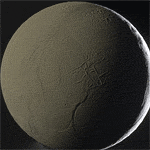
Saturn’s icy moon Enceladus has an underground sea of liquid water, according to the international Cassini spacecraft.

Understanding the interior structure of 500 km-diameter Enceladus has been a top priority of the Cassini mission since plumes of ice and water vapour were discovered jetting from ‘tiger stripe’ fractures at the moon’s south pole in 2005.

Subsequent observations of the jets …

Read the rest of this article

NASA trained several pairs of eyes on Saturn as the planet put on a dancing light show at its poles. While NASA’s Hubble Space Telescope, orbiting around Earth, was able to observe the northern auroras in ultraviolet wavelengths, NASA’s Cassini spacecraft, orbiting around Saturn, got complementary close-up views in infrared, visible-light and ultraviolet wavelengths. Cassini could also see northern and …

Read the rest of this article

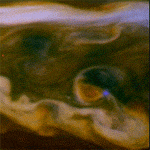
Like a swirl from a paintbrush being dipped in water, this image from the Cassini orbiter shows the progress of a massive storm on Saturn. The storm first developed in December 2010, and this mosaic captures how it appeared on 6 March 2011.

The head of the storm is towards the left of the image, where the most turbulent activity …

Read the rest of this article

NASA’s Cassini spacecraft has obtained the highest-resolution movie yet of a unique six-sided jet stream, known as the hexagon, around Saturn’s north pole.

This is the first hexagon movie of its kind, using color filters, and the first to show a complete view of the top of Saturn down to about 70 degrees latitude. Spanning about 20,000 miles (30,000 kilometers) …

Read the rest of this article

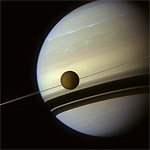
Saturn and Titan

Five moons pose for the international Cassini spacecraft to create this beautiful portrait with Saturn’s rings.

This view, from 29 July 2011, looks toward the northern, sunlit side of the rings from just above the ringplane.

At the far right, and obscuring Saturn itself, is the planet’s second largest moon Rhea, which spans 1528 km. Rhea is closest to Cassini …

Read the rest of this article

With the sun now shining down over the north pole of Saturn’s moon Titan, a little luck with the weather, and trajectories that put the spacecraft into optimal viewing positions, NASA’s Cassini spacecraft has obtained new pictures of the liquid methane and ethane seas and lakes that reside near Titan’s north pole. The images reveal new clues about how the …

Read the rest of this article

Saturn and Titan

NASA’s Cassini spacecraft has detected propylene, a chemical used to make food-storage containers, car bumpers and other consumer products, on Saturn’s moon Titan.

This is the first definitive detection of the plastic ingredient on any moon or planet, other than Earth.

A small amount of propylene was identified in Titan’s lower atmosphere by Cassini’s Composite Infrared Spectrometer (CIRS). This instrument …

Read the rest of this article