Saturn and Titan

The Solar System is a beautiful place filled with wonders that NASA space probes are only beginning to discover. There’s a tendency, though, for people to become indifferent; every year Hubble, Cassini, MESSENGER and other spacecraft beam back gigabytes of jaw-dropping images. After a while, you don’t have any more “gasps” left in you.

Well, maybe just one more. Inhale …

Read the rest of this article

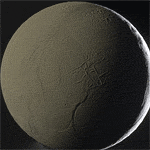
A patchwork network of frozen ridges and troughs cover the face of Enceladus, Saturn’s most enigmatic of icy moons.

This face-on colour view of Enceladus was taken by the international Cassini spacecraft on 31 January 2011, from a distance of 81 000 km, and processed by amateur astronomer Gordan Ugarković.


This face-on colour view of Enceladus was taken by the …

Read the rest of this article

An ice cloud taking shape over Titan’s south pole is the latest sign that the change of seasons is setting off a cascade of radical changes in the atmosphere of Saturn’s largest moon. Made from an unknown ice, this type of cloud has long hung over Titan’s north pole, where it is now fading, according to observations made by the …

Read the rest of this article

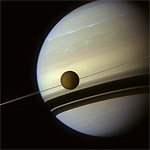
Saturn and Titan
The Cassini spacecraft observes three of Saturn’s moons set against the darkened night side of the planet. Saturn is present on the left this image but is too dark to see. Rhea (1,528 kilometers, or 949 miles across) is closest to Cassini here and appears largest at the center of the image. Enceladus (504 kilometers, or 313 miles across) is…

Read the rest of this article

During a chance encounter with an unusually strong blast of solar wind arriving at Saturn, the international Cassini spacecraft detected particles being accelerated to ultra-high energies, similar to the acceleration that takes place around supernova explosions.


The international Cassini spacecraft exploring the magnetic environment of Saturn. The image is not to scale. Saturn’s magnetosphere is depicted in grey, while the …

Read the rest of this article

Saturn and Titan

Call it a Saturnian version of the Ouroboros, the mythical serpent that bites its own tail. In a new paper that provides the most detail yet about the life and death of a monstrous thunder-and-lightning storm on Saturn, scientists from NASA’s Cassini mission describe how the massive storm churned around the planet until it encountered its own tail and sputtered …

Read the rest of this article

Eight years ago yesterday, ESA’s Huygens bounced, slid and wobbled its way to rest on the surface of Saturn’s moon Titan, the first time a probe had touched down on an alien world in the outer Solar System.


A new rendering of Huygens descent and touchdown created using real data recorded by the probe’s instruments as it descended to the …

Read the rest of this article

It’s not exactly icing on a cake, but it could be icing on a lake. A new paper by scientists on NASA’s Cassini mission finds that blocks of hydrocarbon ice might decorate the surface of existing lakes and seas of liquid hydrocarbon on Saturn’s moon Titan. The presence of ice floes might explain some of the mixed readings Cassini has …

Read the rest of this article

The international Cassini mission has spotted what appears to be a miniature extraterrestrial version of the Nile River: a river valley on Saturn’s moon Titan that stretches more than 400 km from its ‘headwaters’ to a large sea.

It is the first time images have revealed a river system this vast and in such high resolution anywhere beyond Earth.

Scientists …

Read the rest of this article

Scientists using the international Cassini spacecraft have studied the rapid change in seasons on Saturn’s moon Titan, following equinox in August 2009, which saw the formation of a swirling vortex and a build up of exotic gases at unexpectedly high altitudes.


A true-colour image of the south pole vortex observed in Titan’s atmosphere at about 200–300 km altitude, as seen …

Read the rest of this article