Saturn and Titan

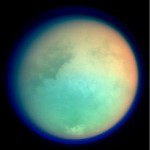
Data from NASA’s Cassini spacecraft have revealed Saturn’s moon Titan likely harbors a layer of liquid water under its ice shell.

Researchers saw a large amount of squeezing and stretching as the moon orbited Saturn. They deduced that if Titan were composed entirely of stiff rock, the gravitational attraction of Saturn would cause bulges, or solid “tides,” on the moon …

Read the rest of this article

Turbulent jet streams, regions where winds blow faster than in other places, churn east and west across Saturn. Scientists have been trying to understand for years the mechanism that drives these wavy structures in Saturn’s atmosphere and the source from which the jets derive their energy.

In a new study appearing in the June edition of the journal Icarus, scientists …

Read the rest of this article

Saturn and Titan

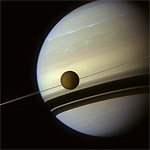
Titan appears to be strung like a bead on Saturn’s rings, which cast shadows onto the southern hemisphere of the gas giant in this beautiful image from Cassini.


Titan and Saturn, seen when the Cassini spacecraft passed by Titan at a distance of 700, 000 km on 6 May 2012. The Cassini-–Huygens mission is a cooperative project of NASA, the …

Read the rest of this article

NASA’s Cassini spacecraft has spied long-standing methane lakes, or puddles, in the “tropics” of Saturn’s moon Titan. One of the tropical lakes appears to be about half the size of Utah’s Great Salt Lake, with a depth of at least 3 feet (1 meter).


Saturn’s rings lie in the distance as the Cassini spacecraft looks toward Titan and its dark …

Read the rest of this article
Saturn's Moon Titan

Saturn’s giant moon Titan hides behind a thick, smoggy atmosphere that’s well known to scientists as one of the most complex chemical environments in the solar system. It’s a productive “factory” cranking out hydrocarbons that rain down on Titan’s icy surface and cloak it in soot. With a brutally cold surface temperature of around minus 270 degrees Fahrenheit (minus 170 …

Read the rest of this article
Scientists working with images from NASA’s Cassini spacecraft have discovered strange half-mile-sized (kilometer-sized) objects punching through parts of Saturn’s F ring, leaving glittering trails behind them. These trails in the rings, which scientists are calling “mini-jets,” fill in a missing link in our story of the curious behavior of the F ring. The results will be presented tomorrow at the …

Read the rest of this article

Saturn's Moon Titan

A region on Saturn’s moon Titan has been found to be similar to the Etosha Pan in Namibia, Africa. Both are ephemeral lakes – large, shallow depressions that sometimes fill with liquid.


Ontario Lacus is Titan’s largest lake in its southern hemisphere. It is an ephemeral lake that resembles Etosha Pan in Namibia, Africa. On Titan the liquid is made …

Read the rest of this article
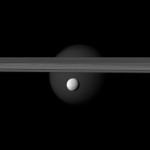
Saturn’s icy moon Enceladus hangs below the gas giant’s rings while Titan lurks in the background, in this new image taken by the Cassini spacecraft.

Faint detail of the tiger stripe markings can be seen on Enceladus’ surface, which is framed against Titan, Saturn’s largest moon. With jets of water ice and vapour streaming from Enceladus’ south pole, and liquid …

Read the rest of this article

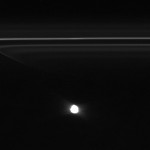
There’s a tiny moon orbiting beyond Saturn’s rings that’s full of promise, and maybe — just maybe — microbes.

In a series of tantalizingly close flybys to the moon, named “Enceladus,” NASA’s Cassini spacecraft has revealed watery jets erupting from what may be a vast underground sea. These jets, which spew through cracks in the moon’s icy shell, could lead …

Read the rest of this article

These raw, unprocessed images of Saturn’s second largest moon, Rhea, were taken on March 10, 2012, by NASA’s Cassini spacecraft. This was a relatively distant flyby with a close-approach distance of 26,000 miles (42,000 kilometers), well suited for global geologic mapping.

During the flyby, Cassini captured these distinctive views of the moon’s cratered surface, creating a 30-frame mosaic of Rhea’s …

Read the rest of this article