A monster storm that erupted on Saturn in late 2010 – as large as any storm ever observed on the ringed planet — has already impressed researchers with its intensity and long-lived turbulence. A new paper in the journal Icarus reveals another facet of the storm’s explosive power: its ability to churn up water ice from great depths. This finding, …

Read the rest of this article
People around the world shared more than 1,400 images of themselves as part of the Wave at Saturn event organized by NASA’s Cassini mission on July 19 — the day the Cassini spacecraft turned back toward Earth to take our picture. The mission has assembled a collage from those images. The collage is online at: http://www.nasa.gov/mission_pages/cassini/multimedia/collage2013.html .

“Thanks to all …

Read the rest of this article

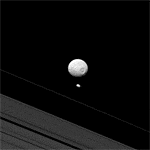
The Saturn moons Mimas and Pandora remind us of how different they are when they appear together, as in this image taken by NASA’s Cassini spacecraft. Pandora’s small size means that it lacks sufficient gravity to pull itself into a round shape like its larger sibling, Mimas. Researchers believe that the elongated shape of Pandora (50 miles, or 81 kilometers …

Read the rest of this article

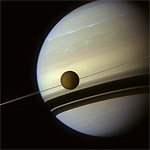
Saturn and Titan

Consider it the first interplanetary photobomb. On July 19th, NASA’s Cassini spacecraft will photograph Earth through the rings of Saturn–and NASA wants you to jump into the shot.

“Cassini has photographed Earth before, but this will be the first time Earthlings know in advance their picture will be taken from a billion miles away,” says Linda Spilker, Cassini project scientist …

Read the rest of this article

On July 19, 2013, NASA’s Cassini spacecraft will photograph Saturn and its entire ring system during a total eclipse of the sun. Cassini has done this twice before during its previous 9 years in orbit, but this time will be different.

“This time, the images to be collected will capture, in natural color, a glimpse of our own planet next …

Read the rest of this article


NASA’s Cassini spacecraft looks toward the night side of Saturn’s largest moon and sees sunlight scattering through the periphery of Titan’s atmosphere and forming a ring of color. Image credit: NASA/JPL-Caltech/Space Science Institute

Scientists working with data from NASA’s Cassini mission have confirmed the presence of a population of complex hydrocarbons in the upper atmosphere of Saturn’s largest moon, Titan, …

Read the rest of this article

Saturn and Titan


The Cassini spacecraft looks down, almost directly at the north pole of Dione. The feature just left of the terminator at bottom is Janiculum Dorsa, a long, roughly north-south trending ridge. Image credit: NASA/JPL/Space Science Institute

From a distance, most of the Saturnian moon Dione resembles a bland cueball. Thanks to close-up images of a 500-mile-long (800-kilometer-long) mountain on the …

Read the rest of this article


These polar maps show the first global, topographic mapping of Saturn’s moon Titan, using data from NASA’s Cassini mission. To create these maps, scientists employed a mathematical process called splining, which uses smooth curved surfaces to “join” the areas between grids of existing topography profiles obtained by Cassini’s radar instrument.Image credit: NASA/JPL-Caltech/ASI/JHUAPL/Cornell/Weizmann

Scientists have created the first global topographic map …

Read the rest of this article

NASA’s Cassini spacecraft has provided scientists the first close-up, visible-light views of a behemoth hurricane swirling around Saturn’s north pole.

In high-resolution pictures and video, scientists see the hurricane’s eye is about 1,250 miles (2,000 kilometers) wide, 20 times larger than the average hurricane eye on Earth. Thin, bright clouds at the outer edge of the hurricane are traveling 330 …

Read the rest of this article

NASA’s Cassini spacecraft has provided the first direct evidence of small meteoroids breaking into streams of rubble and crashing into Saturn’s rings.

These observations make Saturn’s rings the only location besides Earth, the moon and Jupiter where scientists and amateur astronomers have been able to observe impacts as they occur. Studying the impact rate of meteoroids from outside the Saturnian …

Read the rest of this article