Saturn's Moon Dione

NASA’s Cassini spacecraft will zip past Saturn’s moon Dione on Monday, Aug. 17 — the final close flyby of this icy satellite during the spacecraft’s long mission.

Cassini’s closest approach, within 295 miles (474 kilometers) of Dione’s surface, will occur at 11:33 a.m. PDT (2:33 p.m. EDT). Mission controllers expect fresh images to begin arriving on Earth within a couple …

Read the rest of this article

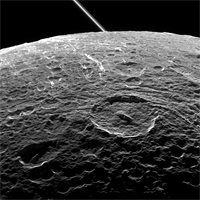
Saturn's Moon Dione

The rugged landscape of Saturn’s fracture-faced moon Dione is revealed in images sent back by NASA’s Cassini spacecraft from its latest flyby. Cassini buzzed past Dione on June 16, coming within 321 miles (516 kilometers) of the moon’s surface.

Raw, unprocessed images from the flyby are available here.

A selection of some of the images is also available.…

Read the rest of this article

Saturn's Moon Titan

Saturn’s moon Titan is home to seas and lakes filled with liquid hydrocarbons, but what makes the depressions they lie in? A new study suggests that the moon’s surface dissolves in a similar process that creates sinkholes on Earth.

Apart from Earth, Titan is the only body in the Solar System known to possess surface lakes and seas, as seen …

Read the rest of this article

Curtain Eruptions on Enceladus

New research using data from NASA’s Cassini mission suggests most of the eruptions from Saturn’s moon Enceladus might be diffuse curtains rather than discrete jets. Many features that appear to be individual jets of material erupting along the length of prominent fractures in the moon’s south polar region might be phantoms created by an optical illusion, according to the new …

Read the rest of this article

During 10 years of discovery, NASA’s Cassini spacecraft has pulled back the smoggy veil that obscures the surface of Titan, Saturn’s largest moon. Cassini’s radar instrument has mapped almost half of the giant moon’s surface; revealed vast, desert-like expanses of sand dunes; and plumbed the depths of expansive hydrocarbon seas. What could make that scientific bounty even more amazing? Well, …

Read the rest of this article

Scientists have paired NASA’s Cassini spacecraft with the National Science Foundation’s Very Long Baseline Array (VLBA) radio-telescope system to pinpoint the position of Saturn and its family of moons to within about 2 miles (4 kilometers). The measurement is some 50 times more precise than those provided by ground-based optical telescopes. The feat improves astronomers’ knowledge of Saturn’s orbit and …

Read the rest of this article

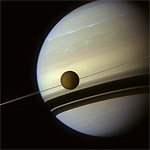
Saturn and Titan

Earth is the only planet in our Solar System to have a single solitary moon. While others, such as Mercury and Venus, have none, the gas giants have accumulated crowds of orbiting bodies — Saturn, for example, boasts an impressive 62 moons!

This image, taken by the Cassini orbiter, shows its two biggest: Rhea and its larger companion Titan. Titan’s …

Read the rest of this article

Compared to the age of the solar system — about four-and-a-half billion years — a couple of decades are next to nothing. Some planetary locales change little over many millions of years, so for scientists who study the planets, any object that evolves on such a short interval makes for a tempting target for study. And so it is with …

Read the rest of this article

Saturn's Moon Titan

The NASA and European Space Agency Cassini mission has revealed hundreds of lakes and seas spread across the north polar region of Saturn’s moon Titan. These lakes are filled not with water but with hydrocarbons, a form of organic compound that is also found naturally on Earth and includes methane. The vast majority of liquid in Titan’s lakes is thought …

Read the rest of this article

Saturn has a great many more moons than our planet – a whopping 62. A single moon, Titan, accounts for an overwhelming 96% of all the material orbit the planet, with a group of six other smaller moons dominating the rest. The other 55 small satellites whizzing around Saturn make up the tiny remainder along with the gas giant’s famous …

Read the rest of this article