NASA and international researchers have discovered that Earth’s moon has more in common than previously thought with large asteroids roaming our solar system.


Scientists have now discovered that studying meteorites from the giant asteroid Vesta helps them understand the event known as the “lunar cataclysm,” when a repositioning of the gas giant planets destabilized a portion of the asteroid belt …
Read the rest of this article

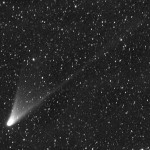
Comet Pan-STARRS (C/2011 L4) is now inside the orbit of Mercury and it is brightening as it approaches the sun. Observers in the southern hemisphere say the comet can be seen with the naked eye even through city lights. Currently, it is about as bright as the stars of the Big Dipper (Ursa Major) (magnitude +2 to +3). The comet …

Read the rest of this article

Far beyond the orbits of Neptune and Pluto, where the sun is a pinprick of light not much brighter than other stars, a vast swarm of icy bodies circles the solar system. Astronomers call it the “Oort Cloud,” and it is the source of some of history’s finest comets.

One of them could be heading our way now.


A comet …

Read the rest of this article

NASA’s Deep Impact spacecraft has acquired its first images of comet C/2012 S1 (ISON). The images were taken by the spacecraft’s Medium-Resolution Imager over a 36-hour period on Jan. 17 and 18, 2013, from a distance of 493 million miles (793 million kilometers). Many scientists anticipate a bright future for comet ISON; the spaceborne conglomeration of dust and ice may …

Read the rest of this article

ESA’s Venus Express has made unique observations of Venus during a period of reduced solar wind pressure, discovering that the planet’s ionosphere balloons out like a comet’s tail on its nightside.


The change in ionosphere of Venus during normal solar wind conditions (left) and reduced solar wind activity (right), as observed by ESA’s Venus Express spacecraft in August 2010. The …

Read the rest of this article

Anyone who’s ever seen a noctilucent cloud or “NLC” would agree: They look alien. The electric-blue ripples and pale tendrils of NLCs reaching across the night sky resemble something from another world.

Researchers say that’s not far off. A key ingredient for the mysterious clouds comes from outer space.

“We’ve detected bits of ‘meteor smoke’ imbedded in noctilucent clouds,” reports …

Read the rest of this article

The second of NASA’s two Gravity Recovery And Interior Laboratory (GRAIL) spacecraft has successfully completed its planned main engine burn and is now in lunar orbit. Working together, GRAIL-A and GRAIL-B will study the moon as never before.


Artist concept of GRAIL-B performing its lunar orbit insertion burn. Image credit: NASA/JPL-Caltech

“NASA greets the new year with a new mission …

Read the rest of this article

On October 8th Earth is going to plow through a stream of dust from Comet 21P/Giacobini-Zinner, and the result could be an outburst of Draconid meteors.

“We’re predicting as many as 750 meteors per hour,” says Bill Cooke of NASA’s Meteoroid Environment Office. “The timing of the shower favors observers in the Middle East, north Africa and parts of Europe.”…

Read the rest of this article

NASA’s MESSENGER spacecraft, the first to achieve orbit around Mercury, is providing scientists new information about the planet. The data show widespread flood volcanism similar to Earth, clearer views of Mercury’s surface, the first measurements of its elemental composition, and details about charged particles near the planet.


Here a high-resolution monochrome image has been combined with a lower-resolution enhanced-color image. …

Read the rest of this article

Comet Elenin is coming to the inner-solar system this fall/autumn. Comet Elenin (also known by its astronomical name C/2010 X1), was first detected on Dec. 10, 2010 by Leonid Elenin, an observer in Lyubertsy, Russia, who made the discovery “remotely” using the ISON-NM observatory near Mayhill, New Mexico. At the time of the discovery, the comet was about 647 million …

Read the rest of this article