Galaxies are not as isolated as they at first glance may seem; on a cosmic scale they congregate in clumps along with dark matter and hot gas. The colourful blob in this new composite image, based on data from several telescopes including ESA’s XMM-Newton, is the group of galaxies known as the Bullet Group. Its components appear to be clearly …

Read the rest of this article

Supernovas are often thought of as the tremendous explosions that mark the ends of massive stars’ lives. While this is true, not all supernovas occur in this fashion. A common supernova class, called Type Ia, involves the detonation of white dwarfs — small, dense stars that are already dead.

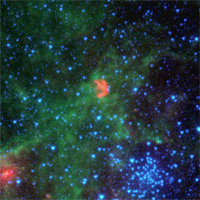
New results from NASA’s Spitzer Space Telescope have revealed a rare …

Read the rest of this article

Astronomers using the Hubble Space Telescope have captured the most comprehensive picture ever assembled of the evolving Universe – and one of the most colourful. The study is called the Ultraviolet Coverage of the Hubble Ultra Deep Field (UVUDF) project.

Prior to this survey, astronomers were in a curious position. They knew a lot about star formation occurring in nearby …

Read the rest of this article

Astronomers have found cosmic clumps so dark, dense and dusty that they throw the deepest shadows ever recorded. Infrared observations from NASA’s Spitzer Space Telescope of these blackest-of-black regions paradoxically light the way to understanding how the brightest stars form.

The clumps represent the darkest portions of a huge, cosmic cloud of gas and dust located about 16,000 light-years away. …

Read the rest of this article

What happens when two neutron stars collide? Using a sophisticated computer simulation, NASA scientists have visualized this violent scenario in awesome degenerate-matter-crushing detail.

Neutron stars are the result of supernovae spawned by stars 8-30 times the mass of our sun. Occasionally, however, two neutron stars may meet, becoming entangled in a deep gravitational embrace. Should this scenario play out, one …

Read the rest of this article

The Monkey Head Nebula (also known as NGC 2174) is a star-forming region in which bright, newborn stars near the center of the nebula illuminate the surrounding gas with energetic radiation. This radiation, along with strong stellar winds, erodes away the lower density gas. Pockets of higher density gas resist this erosion, and form pillars and peaks along the inner …

Read the rest of this article

When we gaze up at the night sky, we are only seeing part of the story. Unfortunately, some of the most powerful and energetic events in the Universe are invisible to our eyes – and to even the best optical telescopes.

Luckily, these events are not lost; they appear vividly in the high-energy sky, making them visible to space-based telescopes …

Read the rest of this article

Hubble Space Telescope

Even though NASA’s Hubble Space Telescope is 24 years old, astronomers are still coming up with imaginative, novel, and groundbreaking new uses for it. The latest is an innovative technique that improves Hubble’s observing accuracy to the point where rock-solid distance measurements can be made to Milky Way stars 10 times farther away than ever accomplished before.

To do this, …

Read the rest of this article

Hubble Space Telescope

NASA’s Hubble Space Telescope has weighed the largest known galaxy cluster in the distant universe, catalogued as ACT-CL J0102-4915, and found it definitely lives up to its nickname — El Gordo (Spanish for “the fat one”).

By measuring how much the cluster’s gravity warps images of galaxies in the distant background, a team of astronomers has calculated the cluster’s mass …

Read the rest of this article

My thanks to Terry Moseley of the Irish Astronomical Association for letting me know about this.

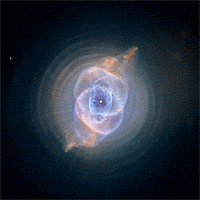
All astronomers know that Planetary Nebulae have absolutely nothing to do with planets: the name is an unfortunate legacy from the 19th century when poorer quality telescope optics failed to resolve these objects properly, making them look like planets. The best known example is …

Read the rest of this article