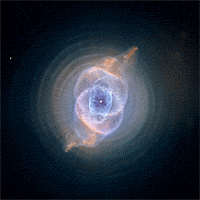
Three thousand light years from Earth, the Cat’s Eye Nebula (NGC 6543) is a sight that draws in the human eye. In this image from the NASA/ESA Hubble Space Telescope, numerous bubbles are visible – shapes generated by the ejection of glowing gas as the star at its centre approaches the end of its life.

While large stars die in …

Read the rest of this article

This festive NASA Hubble Space Telescope image resembles a holiday wreath made of sparkling lights. The bright southern hemisphere star RS Puppis, at the center of the image, is swaddled in a gossamer cocoon of reflective dust illuminated by the glittering star. RS Puppis rhythmically brightens and dims over a six-week cycle. It is one of the most luminous in …

Read the rest of this article

Data from NASA’s Chandra X-ray Observatory has revealed faint remnants of a supernova explosion and helped researchers determine Circinus X-1 — an X-ray binary — is the youngest of this class of astronomical objects found to date.

As the name suggests, X-ray binaries are star systems made up of two parts: a compact stellar remnant — either a neutron star …

Read the rest of this article

This virtual journey shows the different components that make up our home galaxy, the Milky Way, which contains about a hundred billion stars.

It starts at the black hole at the centre of the Milky Way and with the stars that orbit around it, before zooming out through the central Galactic Bulge, which hosts about ten billion stars.

The journey …

Read the rest of this article

Galaxies are social beasts that are mostly found in groups or clusters – large assemblies of galaxies that are permeated by even larger amounts of diffuse gas. With temperatures of 10 million degrees or more, the gas in galaxy groups and clusters is hot enough to shine brightly in X-rays and be detected by ESA’s XMM-Newton X-ray observatory.

As galaxies …

Read the rest of this article

NASA will host a news teleconference at 2 p.m. EST Thursday, Nov. 21, to announce new findings about a record-setting gamma-ray burst observed in unprecedented detail by the agency’s Fermi, Swift and NuSTAR high-energy satellites and by telescopes on the ground.

The journal Science has embargoed the findings until the time of the news conference.

Gamma-ray bursts are the …

Read the rest of this article

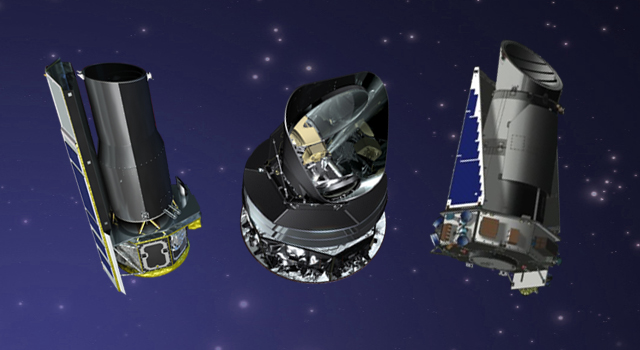
From the tiniest fraction of a second after the Big Bang to the evolution of stars and galaxies over 13.8 billion years, ESA’s Planck space telescope has provided new insight into the history of our Universe. Although science observations are now complete, the legacy of the Planck mission lives on.

Planck was launched in 2009 and spent 4.5 years scanning …

Read the rest of this article

An international team of astronomers has found the most distant gravitational lens yet – a galaxy that, as predicted by Albert Einstein’s general theory of relativity, deflects and intensifies the light of an even more distant object.

The discovery provides a rare opportunity to directly measure the mass of a distant galaxy. The observation also poses a mystery: lenses of …

Read the rest of this article

 
Nestled within the shell around this large bubble is an embryonic star that is already a hefty eight times more massive than our Sun.

This image, by ESA’s Herschel space observatory, was originally presented in the first announcement of scientific results  from the mission in May 2010.

This week Herschel scientists will meet again at ESA’s ESTEC establishment in the …

Read the rest of this article

Astronomers using NASA’s Hubble Space Telescope and Chandra X-ray Observatory and telescopes on the ground may have found the most crowded galaxy in our part of the universe.

The ultra-compact dwarf galaxy, known as M60-UCD1, is packed with an extraordinary number of stars and may be the densest galaxy near Earth. It is providing astronomers with clues to its intriguing …

Read the rest of this article