New observations from NASA’s Hubble Space Telescope have helped astronomers crack a longstanding puzzle about galaxy evolution.

For years, scientists have wondered why galaxies that have ceased forming new stars — so-called “quenched galaxies” — were smaller long ago than they are today. Perhaps, they thought, ancient quenched galaxies continued to grow by merging with smaller cousins that had also …

Read the rest of this article

Chandra X-Ray Observatory

Using data from NASA’s Chandra X-ray Observatory, astronomers have discovered an unprecedented bonanza of black holes in the Andromeda Galaxy, one of the nearest galaxies to the Milky Way.

Using more than 150 Chandra observations, spread over 13 years, researchers identified 26 black hole candidates, the largest number to date, in a galaxy outside our own. Many consider Andromeda to …

Read the rest of this article

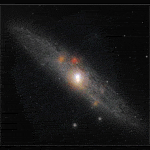
Nearly a decade ago, NASA’s Chandra X-ray Observatory caught signs of what appeared to be a black hole snacking on gas at the middle of the nearby Sculptor galaxy. Now, NASA’s Nuclear Spectroscopic Telescope Array (NuSTAR), which sees higher-energy X-ray light, has taken a peek and found the black hole asleep.


The Sculptor galaxy is seen in a new light, …

Read the rest of this article

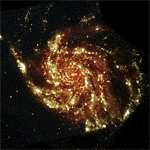
The face-on Pinwheel spiral galaxy seen in the image below is at ultraviolet wavelengths in this image taken by ESA’s XMM-Newton space telescope. Also known as M101, the galaxy lies 21 million light-years away in the constellation Ursa Major. It measures 170 000 light-years across – nearly twice the diameter of our own Milky Way Galaxy – and contains at …

Read the rest of this article


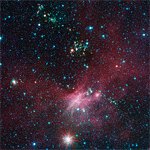
Dozens of newborn stars sprouting jets from their dusty cocoons have been spotted in images from NASA’s Spitzer Space Telescope.

New views from NASA’s Spitzer Space Telescope show blooming stars in our Milky Way galaxy’s more barren territories, far from its crowded core.

The images are part of the Galactic Legacy Infrared Mid-Plane Survey Extraordinaire (Glimpse 360) project, which is …

Read the rest of this article

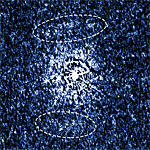
A flash of light from a stellar outburst has been used to probe for the first time the 3-D structure of material ejected by an erupting nova.

Astronomers used NASA’s Hubble Space Telescope to observe the light emitted by the close double-star system T Pyxidis, or T Pyx, a recurrent nova, during its latest outburst in April 2011. Contrary to …

Read the rest of this article


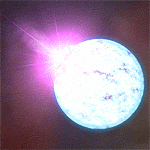
An artist’s rendering of an outburst on an ultra-magnetic neutron star, also called a magnetar.

Astronomers using NASA’s Swift X-ray Telescope have observed a spinning neutron star suddenly slowing down, yielding clues they can use to understand these extremely dense objects.

A neutron star is the crushed core of a massive star that ran out of fuel, collapsed under its …

Read the rest of this article


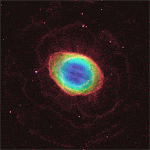
In this composite image, visible-light observations by NASA’s Hubble Space Telescope are combined with infrared data from the ground-based Large Binocular Telescope in Arizona to assemble a dramatic view of the well-known Ring Nebula. Credit: NASA, ESA, C.R. Robert O’Dell (Vanderbilt University), G.J. Ferland (University of Kentucky), W.J. Henney and M. Peimbert (National Autonomous University of Mexico). Credit for Large

Read the rest of this article

A massive and rare merging of two galaxies has been spotted in images taken by the Herschel space observatory, a European Space Agency mission with important NASA participation.

Follow-up studies by several telescopes on the ground and in space, including NASA’s Hubble Space Telescope and Spitzer Space Telescope, tell a tale of two faraway galaxies intertwined and furiously making stars. …

Read the rest of this article

Bright arcs are smeared around the heart of galaxy cluster Abell S1077 in this image taken by the NASA/ESA Hubble space telescope. The arcs are stretched images of distant galaxies distorted by the cluster’s enormous gravitational field.

Galaxy clusters are large groupings of galaxies, each hosting millions of stars. They are the largest existing structures in the Universe, bound by …

Read the rest of this article