NASA’s Hubble Space Telescope has found the building blocks for Earth-sized planets in an unlikely place– the atmospheres of a pair of burned-out stars called white dwarfs.

These dead stars are located 150 light-years from Earth in a relatively young star cluster, Hyades, in the constellation Taurus. The star cluster is only 625 million years old. The white dwarfs are …

Read the rest of this article

ESA’s Herschel space observatory has discovered an extremely distant galaxy making stars more than 2000 times faster than our own Milky Way. Seen at a time when the Universe was less than a billion years old, its mere existence challenges our theories of galaxy evolution.


Artist’s impression of starburst galaxy HFLS3. The galaxy appears as little more than a faint, …

Read the rest of this article

In science fiction, finding antimatter on board your spaceship is not good news. Usually, it means you’re moments away from an explosion.

In real life, though, finding antimatter could lead to a Nobel Prize.

On April 3rd, researchers led by Nobel Laureate Samuel Ting of MIT announced that the Alpha Magnetic Spectrometer, a particle detector operating onboard the International Space …

Read the rest of this article

NASA’s Kepler space telescope has witnessed the effects of a dead star bending the light of its companion star. The findings are among the first detections of this phenomenon — a result of Einstein’s general theory of relativity — in binary, or double, star systems.


This artist’s animation depicts an ultra-dense dead star, called a white dwarf, passing in front …

Read the rest of this article

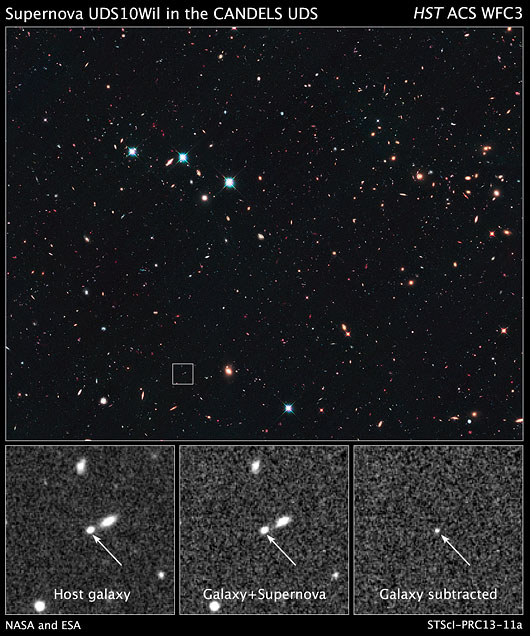
NASA’s Hubble Space Telescope has found the farthest supernova so far of the type used to measure cosmic distances. Supernova UDS10Wil, nicknamed SN Wilson after American President Woodrow Wilson, exploded more than 10 billion years ago.


This is a Hubble Space Telescope view looking long ago and far away at a supernova that exploded over 10 billion years ago. The …

Read the rest of this article

The antimatter hunter AMS-02 on the International Space Station is searching for the missing pieces of our Universe. The project’s first results published today are hinting at a new phenomenon and revealing more about the invisible ‘dark matter’.

AMS-02, the Alpha Magnetic Spectrometer, consists of seven instruments that monitor cosmic rays from space. Unprotected by Earth’s atmosphere the instruments receive …

Read the rest of this article

Astronomers have watched as a black hole woke up from a decades-long slumber to feed on a low-mass object – either a brown dwarf or a giant planet – that strayed too close. A similar feeding event, albeit on a gas cloud, will soon happen at the black hole at the centre of our own Milky Way Galaxy.

Loading…


jwplayer("pi_player").setup({ …

Read the rest of this article

This three-colour image of the W3 giant molecular cloud combines Herschel bands at 70 μm (blue), 160 μm (green) and 250 μm (red). The image spans about 2 x 2 degrees. North is up and east is to the left. W3 is an enormous stellar nursery about 6200 light-years away in the Perseus Arm, one of the Milky Way galaxy’s…

Read the rest of this article

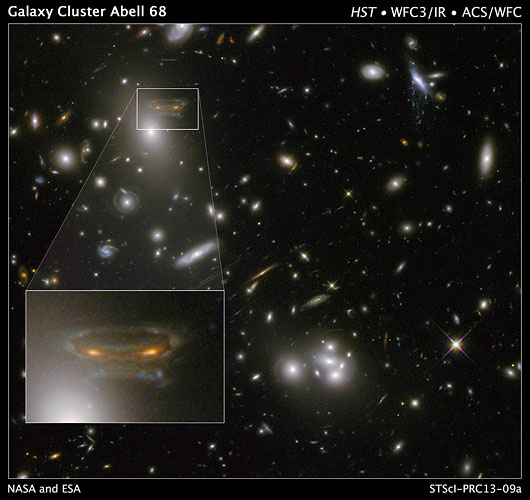
The universe is eerie enough without giving us an apparition of a 1980s video game alien attacker. This oddball-looking object is really a mirage created by the gravitational field of a foreground cluster of galaxies warping space and distorting the background images of more distant galaxies.


The gravitational field surrounding this massive cluster of galaxies, Abell 68, acts as a …

Read the rest of this article

Black Hole

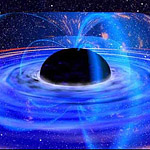
Two X-ray space observatories, NASA’s Nuclear Spectroscopic Telescope Array (NuSTAR) and the European Space Agency’s XMM-Newton, have teamed up to measure definitively, for the first time, the spin rate of a black hole with a mass 2 million times that of our sun.


This artist’s concept illustrates a supermassive black hole with millions to billions times the mass of our …

Read the rest of this article