Hubble Space Telescope

Using NASA’s Hubble Space Telescope, astronomers announced Dec. 12 they have seen further back in time than ever before and have uncovered a previously unseen population of seven primitive galaxies that formed more than 13 billion years ago, when the universe was less than 3 percent of its present age. The deepest images to date from Hubble yield the first …

Read the rest of this article

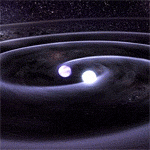
Using computer simulations, scientists from the NASA Astrobiology Institute team at the University of Hawaii are shedding light on a question that has challenged astronomers for years: What causes wide binary stars?


The widest binaries and triple systems have very elongated orbits, so the stars spend most of their time far apart. But once in every orbital revolution they are …

Read the rest of this article

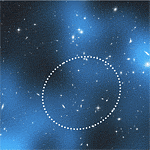
Now you see it, now you don’t. Douglas Clowe of Ohio University in Athens, Ohio, is reporting on new Hubble observations that do not find an unusually dense clump of dark matter in the universe that a different Hubble team reported on earlier this year.


These composite images, taken by two different teams using the Hubble Space Telescope, show different …

Read the rest of this article

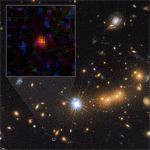
By combining the power of NASA’s Hubble and Spitzer space telescopes and one of nature’s own natural “zoom lenses” in space, astronomers have set a new record for finding the most distant galaxy seen in the universe.


In this image (click it for a larger view), astronomers use NASA’s Hubble Space Telescope and a cosmic zoom lens to uncover the …

Read the rest of this article

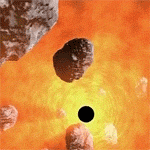
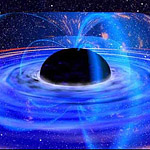
Deep in the heart of the spiral Milky Way galaxy, a hot vortex of matter swirls around a black hole more than a million times as massive as the sun. Many galaxies, perhaps all, contain such a “monster in the middle.” These supermassive black holes sustain themselves by swallowing stars, planets, asteroids, comets and clouds of gas that wander by …

Read the rest of this article

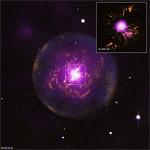
Astronomers have found evidence for a dying Sun-like star coming briefly back to life after casting its gassy shells out into space, mimicking the possible fate our own Solar System faces in a few billion years.


The intricate pattern of planetary nebula Abell 30 is revealed in these images that combine optical Hubble Space Telescope (HST) images with XMM-Newton and …

Read the rest of this article

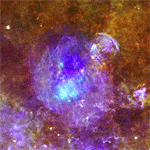
The aftershock of a stellar explosion rippling through space is captured in this new view of supernova remnant W44, which combines far-infrared and X-ray data from ESA’s Herschel and XMM-Newton space observatories.


Supernova remnant W44 is the focus of this new image created by combining data from ESA’s Herschel and XMM-Newton space observatories. W44 is the vast purple sphere that …

Read the rest of this article

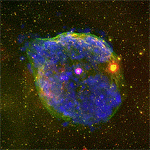
The cosmic cauldron has brewed up a Halloween trick in the form of a ghostly face that glows in X-rays, as seen by ESA’s XMM-Newton space telescope. The eerie entity is a bubble bursting with the fiery stellar wind of a ‘live fast, die young’ star.


A giant bubble blown by the massive Wolf-Rayet star HD 50896, the pink star …

Read the rest of this article

A new study using data from NASA’s Spitzer Space Telescope suggests a cause for the mysterious glow of infrared light seen across the entire sky. It comes from isolated stars beyond the edges of galaxies. These stars are thought to have once belonged to the galaxies before violent galaxy mergers stripped them away into the relatively empty space outside of …

Read the rest of this article

NASA’s newest set of X-ray eyes in the sky, the Nuclear Spectroscopic Telescope Array (NuSTAR), has caught its first look at the giant black hole parked at the center of our galaxy. The observations show the typically mild-mannered black hole during the middle of a flare-up.


NASA’s Nuclear Spectroscopic Telescope Array, or NuSTAR, has captured these first, focused views of …

Read the rest of this article