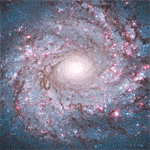
A comprehensive study of hundreds of galaxies observed by the Keck telescopes in Hawaii and NASA’s Hubble Space Telescope has revealed an unexpected pattern of change that extends back 8 billion years, or more than half the age of the universe.


A study of 544 star-forming galaxies observed by the Keck and Hubble telescopes shows that disk galaxies like our …

Read the rest of this article

ESA’s Herschel space observatory has discovered enough water vapour to fill Earth’s oceans more than 2000 times over, in a gas and dust cloud that is on the verge of collapsing into a new Sun-like star.


Herschel’s infrared view of part of the Taurus Molecular Cloud, within which the bright, cold pre-stellar cloud L1544 can be seen at the lower …

Read the rest of this article

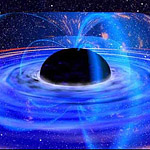
NASA’s Swift satellite recently detected a rising tide of high-energy X-rays from a source toward the center of our Milky Way galaxy. The outburst, produced by a rare X-ray nova, announced the presence of a previously unknown stellar-mass black hole.

“Bright X-ray novae are so rare that they’re essentially once-a-mission events and this is the first one Swift has seen,” …

Read the rest of this article

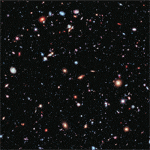
Like photographers assembling a portfolio of best shots, astronomers have assembled a new, improved portrait of mankind’s deepest-ever view of the universe. Called the eXtreme Deep Field, or XDF, the photo was assembled by combining 10 years of NASA Hubble Space Telescope photographs taken of a patch of sky at the center of the original Hubble Ultra Deep Field. The …

Read the rest of this article

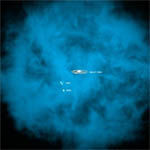
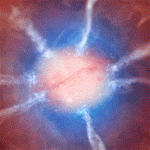
Astronomers have used NASA’s Chandra X-ray Observatory to find evidence our Milky Way Galaxy is embedded in an enormous halo of hot gas that extends for hundreds of thousands of light years. The estimated mass of the halo is comparable to the mass of all the stars in the galaxy.


This artist’s illustration shows an enormous halo of hot gas …

Read the rest of this article

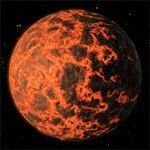
Astronomers have discovered a veritable rogues’ gallery of odd exoplanets – from scorching hot worlds with molten surfaces to frigid ice balls.

And while the hunt continues for the elusive “blue dot” – a planet with roughly the same characteristics as Earth – new research reveals that life might actually be able to survive on some of the many exoplanetary …

Read the rest of this article

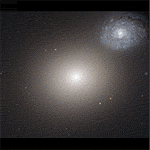
Two very different galaxies drift through space together in this image taken by NASA’s Hubble Space Telescope.

The peculiar galaxy pair is called Arp 116. Arp 116 is composed of a giant elliptical galaxy known as Messier 60 (or M60) and a much smaller spiral galaxy, NGC 4647. M60 is the third brightest galaxy in the Virgo cluster of galaxies, …

Read the rest of this article

This comes in courtesy of Terry Moseley at the Irish Astronomical Association (IAA):

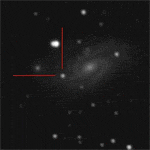
Many congratulations to Dave Grennan for discovering his second supernova – and not from some dark sky site with an ideal climate, but from his own observatory in Raheny, Dublin! Dave used his 36cm Schmidt Cassegrain telescope for the discovery images.


Dave Grennan (left) and his wife …

Read the rest of this article

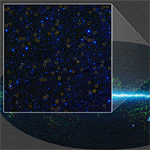
NASA’s Wide-field Infrared Survey Explorer (WISE) mission has led to a bonanza of newfound supermassive black holes and extreme galaxies called hot DOGs, or dust-obscured galaxies.


With its all-sky infrared survey, NASA’s Wide-field Infrared Survey Explorer, or WISE, has identified millions of quasar candidates. Quasars are supermassive black holes with masses millions to billions times greater than our sun. The …

Read the rest of this article

Astronomers have found an extraordinary galaxy cluster, one of the largest objects in the universe, that is breaking several important cosmic records. Observations of the Phoenix cluster with NASA’s Chandra X-ray Observatory, the National Science Foundation’s South Pole Telescope, and eight other world-class observatories may force astronomers to rethink how these colossal structures and the galaxies that inhabit them evolve.…

Read the rest of this article