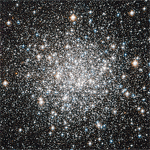
The NASA/ESA Hubble Space Telescope offers this delightful view of the crowded stellar encampment called Messier 68, a spherical, star-filled region of space known as a globular cluster.


Messier 68 is located about 33 000 light-years from Earth in the constellation Hydra (The Female Water Snake). French astronomer Charles Messier notched the object as the 68th entry in his famous …

Read the rest of this article

The violent behaviour of a young Sun-like star spinning at high speed and spewing out super-hot plasma has been revealed thanks to the combined X-ray vision of three space telescopes, including ESA’s XMM-Newton.


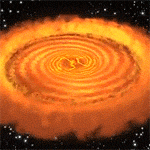
An artist’s impression of what might be happening behind the thick dust disc surrounding the young Sun-like star V1647 Ori. X-ray observations by ESA’s XMM-Newton, NASA’s Chandra …

Read the rest of this article

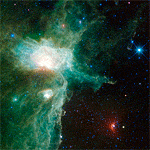
A new image from NASA’s Wide-field Infrared Survey Explorer, or WISE, shows the candle-like Flame nebula lighting up a cavern of dust. The Flame nebula is part of the Orion complex, a turbulent star-forming area located near the constellation’s star-studded belt.


The Flame Nebula sits on the eastern hip of Orion the Hunter, a constellation most easily visible in the …

Read the rest of this article

Seeing is believing, except when you don’t believe what you see. Astronomers using NASA’s Hubble Space Telescope have found a puzzling arc of light behind an extremely massive cluster of galaxies residing 10 billion light-years away. The galactic grouping, discovered by NASA’s Spitzer Space Telescope, was observed as it existed when the universe was roughly a quarter of its current …

Read the rest of this article

Black holes in the early universe needed a few snacks rather than one giant meal to fuel their quasars and help them grow, according to observations from NASA’s Spitzer and Hubble space telescopes.


The galaxies pictured here have so much dust surrounding them that the brilliant light from their quasars cannot be seen in these images NASA’s Hubble Space Telescope. …

Read the rest of this article

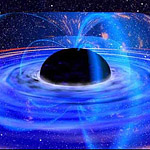
New evidence from NASA’s Chandra X-ray Observatory challenges prevailing ideas about how black holes grow in the centers of galaxies. Astronomers long have thought that a supermassive black hole and the bulge of stars at the center of its host galaxy grow at the same rate — the bigger the bulge, the bigger the black hole. However, a new study …

Read the rest of this article

Astronomers are getting to know the neighbors better. Our sun resides within a spiral arm of our Milky Way galaxy about two-thirds of the way out from the center. It lives in a fairly calm, suburb-like area with an average number of stellar residents. Recently, NASA’s Wide-field Infrared Survey Explorer, or WISE, has been turning up a new crowd of …

Read the rest of this article

The faint, lumpy glow given off by the very first objects in the universe may have been detected with the best precision yet, using NASA’s Spitzer Space Telescope. These faint objects might be wildly massive stars or voracious black holes. They are too far away to be seen individually, but Spitzer has captured new, convincing evidence of what appears to …

Read the rest of this article

Astronomers have found strong evidence that a massive black hole is being ejected from its host galaxy at a speed of several million miles per hour. New observations from NASA’s Chandra X-ray Observatory suggest that the black hole collided and merged with another black hole and received a powerful recoil kick from gravitational wave radiation.


The galaxy at the center …

Read the rest of this article

Giant bubbles, towering pillars and cascading clouds of dust and gas fill the star-forming nursery of the Carina Nebula seen here in a stunning new view from Herschel to launch ESA Space Science’s image of the week feature.


The Carina Nebula, by ESA’s Herschel space observatory. The image (enlarged view) shows the effects of massive star formation – …

Read the rest of this article