Black Hole

How do you grow a supermassive black hole that is a million to a billion times the mass of our sun? Astronomers do not know the answer, but a new study using data from NASA’s Wide-field Infrared Survey Explorer, or WISE, has turned up what might be the cosmic seeds from which a black hole will sprout. The results are …

Read the rest of this article

Massive stars are born in tumultuous clouds of gas and dust. They lead a brief but intense life, blowing powerful winds of particles and radiation that strike their surroundings, before their explosive demise as supernovas.

The interplay between massive stars and their environment is revealed in this image of the star-forming region ON2. It combines X-ray coverage from ESA’s XMM-Newton …

Read the rest of this article

Touring the Milky Way now is as easy as clicking a button with NASA’s new zoomable, 360-degree mosaic presented Thursday at the TEDActive 2014 Conference in Vancouver, Canada.

The star-studded panorama of our galaxy is constructed from more than 2 million infrared snapshots taken over the past 10 years by NASA’s Spitzer Space Telescope.

“If we actually printed this out, …

Read the rest of this article

Astronomers have used NASA’s Chandra X-ray Observatory and the European Space Agency’s (ESA’s) XMM-Newton to show a supermassive black hole six billion light years from Earth is spinning extremely rapidly. This first direct measurement of the spin of such a distant black hole is an important advance for understanding how black holes grow over time.

Black holes are defined by …

Read the rest of this article

Our spiral-shaped Milky Way galaxy lives in a comparatively quiet backwater region of the universe. This is not the case for galaxies crammed together inside huge clusters. As they zip around within a cluster, gas can be pulled from their disks due to a process called ram pressure stripping. Galaxy ESO 137-001 is one example. The star-city looks like it …

Read the rest of this article

The closest supernova of its kind to be observed in the last few decades has sparked a global observing campaign involving legions of instruments on the ground and in space, including NASA’s Spitzer Space Telescope. With its dust-piercing infrared vision, Spitzer brings an important perspective to this effort by peering directly into the heart of the aftermath of the stellar …

Read the rest of this article

This is a Hubble Space Telescope composite image of a supernova explosion designated SN 2014J in the galaxy M82. At a distance of approximately 11.5 million light-years from Earth it is the closest supernova of its type discovered in the past few decades. The explosion is categorized as a Type Ia supernova, which is theorized to be triggered in binary …

Read the rest of this article

The vibrant magentas and blues in this Hubble image of the barred spiral galaxy M83 reveal that the galaxy is ablaze with star formation. The galactic panorama unveils a tapestry of the drama of stellar birth and death. The galaxy, also known as the Southern Pinwheel, lies 15 million light-years away in the constellation Hydra.

This image is a composite …

Read the rest of this article

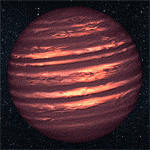
Swirling, stormy clouds may be ever-present on cool celestial orbs called brown dwarfs. New observations from NASA’s Spitzer Space Telescope suggest that most brown dwarfs are roiling with one or more planet-size storms akin to Jupiter’s “Great Red Spot.”

“As the brown dwarfs spin on their axis, the alternation of what we think are cloud-free and cloudy regions produces a …

Read the rest of this article

The first of a set of unprecedented, super-deep views of the universe from an ambitious collaborative program called The Frontier Fields is being released today at the 223rd meeting of the American Astronomical Society in Washington, D.C.

The long-exposure image taken with NASA’s Hubble Space Telescope is the deepest-ever picture taken of a cluster of galaxies, and also contains images …

Read the rest of this article