Researchers using NASA’s Hubble Space Telescope and Chandra X-ray Observatory have uncovered young, massive, compact galaxies whose raucous star-making parties are ending early. The firestorm of star birth has blasted out most of the remaining gaseous fuel needed to make future generations of stars. Now the party’s over for these gas-starved galaxies, and they are on track to possibly becoming …

Read the rest of this article

Chandra X-Ray Observatory

The same phenomenon that causes a bumpy airplane ride, turbulence, may be the solution to a long-standing mystery about stars’ birth, or the absence of it, according to a new study using data from NASA’s Chandra X-ray Observatory.

Galaxy clusters are the largest objects in the universe, held together by gravity. These behemoths contain hundreds or thousands of individual galaxies …

Read the rest of this article

Many celestial objects are beautiful – swirling spiral galaxies or glittering clusters of stars are notable examples. But some of the most striking scenes are created during the death throes of intermediate-mass stars, when great clouds of superheated gas are expelled into space. These dying breaths form planetary nebulas like NGC 6302, captured here in this image from the NASA/ESA …

Read the rest of this article

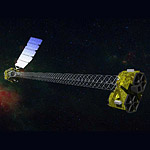
Astronomers have found a pulsating, dead star beaming with the energy of about 10 million suns. This is the brightest pulsar – a dense stellar remnant left over from a supernova explosion – ever recorded. The discovery was made with NASA’s Nuclear Spectroscopic Telescope Array, or NuSTAR.

“You might think of this pulsar as the ‘Mighty Mouse’ of stellar remnants,” …

Read the rest of this article

Astronomers have found an unlikely object in an improbable place: a monster black hole lurking inside one of the tiniest galaxies known.

Though the black hole is five times the mass of the black hole at the center of our Milky Way, it is inside a galaxy that crams 140 million stars within a diameter of about 300 light-years, only …

Read the rest of this article

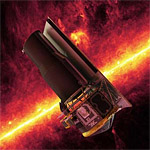
A new survey of galaxies by NASA’s Spitzer Space Telescope is taking a plunge into the deep and uncharted waters of our cosmos. In one of the longest surveys the telescope will have ever performed, astronomers have begun a three-month expedition trawling for faint galaxies billions of light-years away.

The results are already yielding surprises.

“If you think of our …

Read the rest of this article

Astronomers using NASA’s Hubble Space Telescope have discovered a companion star to a rare type of supernova. This observation confirms the theory that the explosion originated in a double-star system where one star fueled the mass-loss from the aging primary star.

This detection is the first time astronomers have been able to put constraints on the properties of the companion …

Read the rest of this article

Massive stars end their life with a bang, exploding as supernovas and releasing massive amounts of energy and matter. What remains of the star is a small and extremely dense remnant: a neutron star or a black hole.

Neutron stars come in several flavours, depending on properties such as their ages, the strength of the magnetic field concealed beneath their …

Read the rest of this article

Astronomers using ESA’s Integral gamma-ray observatory have demonstrated beyond doubt that dead stars known as white dwarfs can reignite and explode as supernovae. The finding came after the unique signature of gamma rays from the radioactive elements created in one of these explosions was captured for the first time.

The explosions in question are known as Type Ia supernovae, long …

Read the rest of this article

Once every 50 years, more or less, a massive star explodes somewhere in the Milky Way. The resulting blast is terrifyingly powerful, pumping out more energy in a split second than the sun emits in a million years. At its peak, a supernova can outshine the entire Milky Way.

It seems obvious that you wouldn’t want a supernova exploding near …

Read the rest of this article