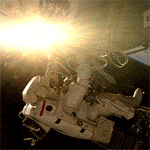
Since Europe’s Columbus laboratory module was attached to the International Space Station five years ago, it has offered researchers worldwide the opportunity to conduct science beyond the effects of gravity.

A total of 110 ESA-led experiments involving some 500 scientists have been conducted since 2008, spanning fluid physics, material sciences, radiation physics, the Sun, the human body, biology and astrobiology. …

Read the rest of this article

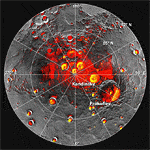
NASA has recently discovered a very strange planet. Its days are twice as long as its years. It has a tail like a comet. It is hot enough to melt lead, yet capped by deposits of ice. And to top it all off … it appears to be pink.

The planet is Mercury.

Of course, astronomers have known about Mercury …

Read the rest of this article

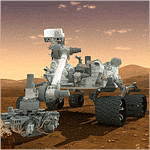
Curiosity Mars Rover

NASA’s Curiosity rover has, for the first time, used a drill carried at the end of its robotic arm to bore into a flat, veiny rock on Mars and collect a sample from its interior. This is the first time any robot has drilled into a rock to collect a sample on Mars.


At the center of this image from …

Read the rest of this article

NASA

NASA will host its first Google+ Hangout live with the International Space Station from 11 a.m. to noon EST, Friday, Feb. 22. This event will connect NASA’s social media followers with astronauts on the ground and living and working aboard the laboratory orbiting 240 miles above Earth.

Google+ Hangouts allow as many as 10 people to chat face-to-face, while thousands …

Read the rest of this article

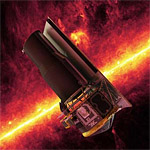
Two of NASA’s Great Observatories, the Spitzer and Hubble space telescopes, have teamed up to uncover a mysterious infant star that behaves like a police strobe light.


NASA’s Spitzer and Hubble space telescopes have teamed up to uncover a mysterious infant star that behaves like a police strobe light. Image credit: NASA, ESA, J. Muzerolle (STScI), E. Furlan (NOAO and …

Read the rest of this article

Full Moon Silhouettes is a real time video of the moon rising over the Mount Victoria Lookout in Wellington, New Zealand. People had gathered up there this night to get the best view possible of the moon rising. Astrophotographer Mark Gee captured the video from 2.1km away on the other side of the city. It’s something that he’s been wanting …

Read the rest of this article

Far beyond the orbits of Neptune and Pluto, where the sun is a pinprick of light not much brighter than other stars, a vast swarm of icy bodies circles the solar system. Astronomers call it the “Oort Cloud,” and it is the source of some of history’s finest comets.

One of them could be heading our way now.


A comet …

Read the rest of this article

NASA’s Deep Impact spacecraft has acquired its first images of comet C/2012 S1 (ISON). The images were taken by the spacecraft’s Medium-Resolution Imager over a 36-hour period on Jan. 17 and 18, 2013, from a distance of 493 million miles (793 million kilometers). Many scientists anticipate a bright future for comet ISON; the spaceborne conglomeration of dust and ice may …

Read the rest of this article

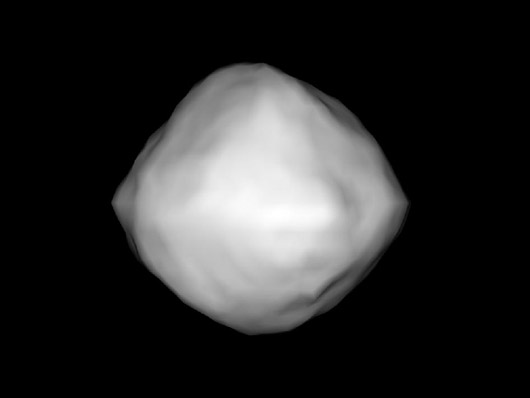
On February 15 near-earth Asteroid 2012 DA14 will come so close to Earth that it will pass inside the orbits of the geostationary satellites. The asteroid, which is about 45-50 metres (148-165 feet) in diameter will pass about 33,600 km (21,000 miles) from the center of the Earth, or about 27,200 km (17,000 miles) above the surface.


Plot of Asteroid …

Read the rest of this article

Living in space weakens astronauts’ immune systems, researchers have discovered. The findings are providing clues on how to tackle diseases on Earth before symptoms appear.

Ever since the first humans ventured into space we have known that astronauts can suffer from common infections that would be quickly dealt with by healthy people on Earth. Until now, it was not clear …

Read the rest of this article