Bright and dark cloud bands wind around the poles of Venus in this beautiful sequence tracked by ESA’s Venus Express as it makes a rollercoaster orbit around the planet.

We join the spacecraft from a staggering 66,000 km above the south pole, staring down into the swirling south polar vortex. From this bird’s-eye view, half of the planet is in …

Read the rest of this article

Mars


This view of layered rocks on the floor of McLaughlin Crater shows sedimentary rocks that contain spectroscopic evidence for minerals formed through interaction with water. The High Resolution Imaging Science Experiment (HiRISE) camera on NASA’s Mars Reconnaissance Orbiter recorded the image. A combination of clues suggests this 1.4-mile-deep (2.2-kilometer-deep) crater once held a lake fed by groundwater. Part of the …

Read the rest of this article

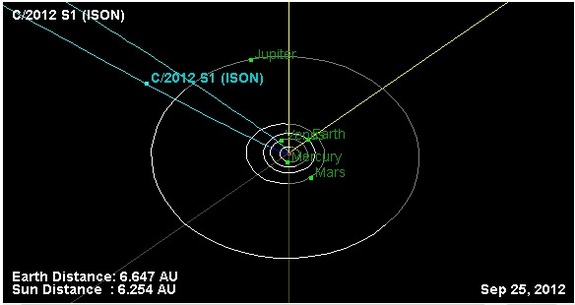
Out near the orbit of Jupiter, a faint speck of light is moving through the black of space. At first glance it doesn’t look like much, no brighter than a thousand distant stars speckling the velvet sky behind it; indeed, it takes a big telescope make out that it is a comet.

But what a comet it could turn out …

Read the rest of this article

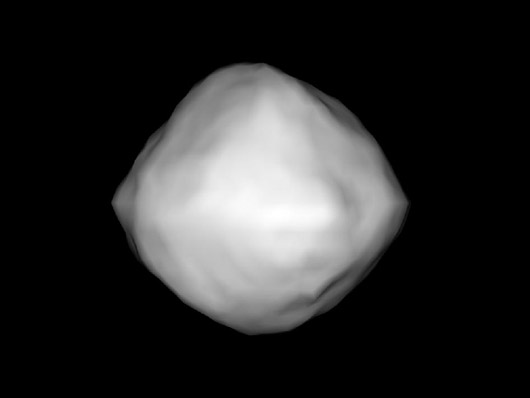
A space rock several hundred metres across is heading towards our planet and the last-ditch attempt to avert a disaster – an untested mission to deflect it – fails. This fictional scene of films and novels could well be a reality one day. But what can space agencies do to ensure it works?


The US-European Asteroid Impact and Deflection mission …

Read the rest of this article

Eight years ago yesterday, ESA’s Huygens bounced, slid and wobbled its way to rest on the surface of Saturn’s moon Titan, the first time a probe had touched down on an alien world in the outer Solar System.


A new rendering of Huygens descent and touchdown created using real data recorded by the probe’s instruments as it descended to the …

Read the rest of this article

Mars

StarGazing Live is a program run over 3 consecutive days by the BBC at the beginning of each year. This year, it ran from Jan 8th-10th (other things have prevented me from writing out it this week).

The programs cover a range of topics in the world of astronomy and are co-presented live by Prof. Brian Cox and comedian Dara …

Read the rest of this article

One of the biggest sunspots of the current solar cycle is now turning toward Earth. Named AR1654, the active region is crackling with medium-sized (M-class) flares and could be poised to break the recent spell of calm space weather around our planet. It poses a threat for even stronger eruptions. NOAA forecasters estimate a 5% chance of X-flares today.


Active …

Read the rest of this article


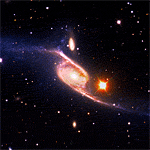
This composite of the giant barred spiral galaxy NGC 6872 combines visible light images from the European Southern Observatory’s Very Large Telescope with far-ultraviolet (1,528 angstroms) data from NASA’s GALEX and 3.6-micron infrared data acquired by NASA’s Spitzer Space Telescope. A previously unsuspected tidal dwarf galaxy candidate (circled) appears only in the ultraviolet, indicating the presence of many hot young …

Read the rest of this article

January 9, 2013

Event: Supernova 2013E in IC 2532 = PSN J10000552-3414013

Discovered by: Stuart Parker (Canterbury, New Zealand)

Discovery Date: 2013 Jan. 4.58 UT

Discovery Magnitude: red mag 14.8 on a 30-s unfiltered CCD image taken with a 30-cm Astro-Tech AT12RC Ritchey-Chretien astrograph (+ ST10 camera) at his Parkdale Observatory in the course of the Backyard Observatory Supernova Search …

Read the rest of this article


ESA’s Herschel Space Observatory captured asteroid Apophis in its field of view during the approach to Earth on 5/6 January 2013. This image shows the asteroid in Herschel’s three PACS wavelengths: 70, 100 and 160 microns, respectively. Its closest pass, on 9 January 2013, brings it to 14.45 million km from Earth, 35–40 times that of the distance of the …

Read the rest of this article