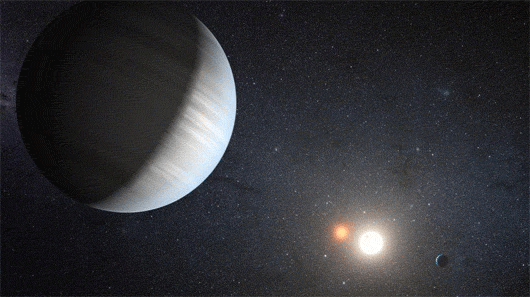
NASA’s Kepler mission scientists have discovered a new planetary system that is home to the smallest planet yet found around a star similar to our sun.

The planets are located in a system called Kepler-37, about 210 light-years from Earth in the constellation Lyra. The smallest planet, Kepler-37b, is slightly larger than our moon, measuring about one-third the size of …

Read the rest of this article

The Sun

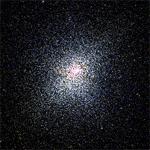
ESA’s Herschel space observatory has detected a cool layer in the atmosphere of Alpha Centauri A, the first time this has been seen in a star beyond our own Sun. The finding is not only important for understanding the Sun’s activity, but could also help in the quest to discover proto-planetary systems around other stars.


One of the great curiosities …

Read the rest of this article

Back in November, the BBC aired a documentary called “Do We Really Need The Moon?” in which Dr. Maggie Aderin-Pocock (a Moon fanatic) explores our intimate relationship with the Moon. Besides causing the tides, the moon dictates the length of a day, the rhythm of the seasons and the very stability of our planet (the documentary originally aired in 2011). …

Read the rest of this article

I happened to be surfing through various random sites today when I came across this site that’s actually been created as an experiment by some of the bods over at Google.

Called “100,000 Stars“, it’s an interactive visualization of the stellar neighborhood created for the Google Chrome web browser – don’t worry it works just as well in …

Read the rest of this article

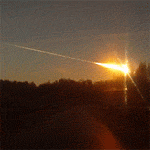
I’m sure you heard about the damage and injuries caused by a meteor detonating over Chelyabinsk in Russia last week. Russia, seems a bit unfortunate in this respect as a similar, but larger, event occurred over Siberia in 1908 – The Tunguska Event and another event – the Sikhote-Alin event – happened in 1947. The Chelyabinsk meteor blast was the …

Read the rest of this article

During a chance encounter with an unusually strong blast of solar wind arriving at Saturn, the international Cassini spacecraft detected particles being accelerated to ultra-high energies, similar to the acceleration that takes place around supernova explosions.


The international Cassini spacecraft exploring the magnetic environment of Saturn. The image is not to scale. Saturn’s magnetosphere is depicted in grey, while the …

Read the rest of this article

A space rock a few metres across exploded in Earth’s atmosphere above the city of Chelyabinsk, Russia today at about 03:15 GMT. The numerous injuries and significant damage remind us that what happens in space can affect us all. At least 950 people were injured as the shockwave blew out windows and rocked buildings. Most of those hurt, in the …

Read the rest of this article

NASA

NASA Television will provide commentary starting at 2 p.m. EST (11 a.m. PST / 7 p.m. UTC) on Friday, Feb. 15, during the close, but safe, flyby of a small near-Earth asteroid named 2012 DA14. NASA places a high priority on tracking asteroids and protecting our home planet from them. This flyby will provide a unique opportunity for researchers to …

Read the rest of this article

Do you want to contribute to the study of the cosmos, but don’t have an astronomy degree or even a telescope? Well, here’s a solution for you. Use your free time and your computer to analyze real data from Hubble and other space telescopes. Visit HubbleSite’s new citizen science portal to find active astronomy projects that you can get involved …

Read the rest of this article

Pluto and Charon

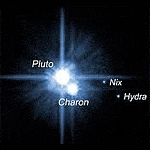
Pluto may have been demoted, but its family is getting bigger and bigger. Now, two of the dwarf planet’s tiniest moons need names — but rather than leaving the Plutonian satellites’ naming ceremony to astronomers, that honor has fallen to you.


The Plutonian system detailing the orbits of Charon, Nix, Hydra, “P4″ and “P5.” Image credit: NASA

The discoverers of …

Read the rest of this article