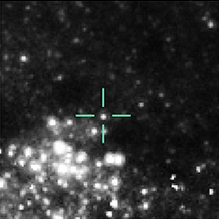
Eta Carinae Twin Star In M83

Eta Carinae, the most luminous and massive stellar system within 10,000 light-years, is best known for an enormous eruption seen in the mid-19th century that hurled an amount of material at least 10 times the sun’s mass into space. This expanding veil of gas and dust, which still shrouds Eta Carinae, makes it the only object of its kind known …

Read the rest of this article

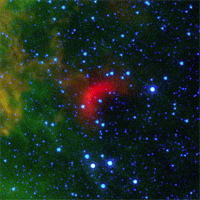
Stellar Bow Shock Waves

Astronomers are finding dozens of the fastest stars in our galaxy with the help of images from NASA’s Spitzer Space Telescope and Wide-field Infrared Survey Explorer, or WISE.

When some speedy, massive stars plow through space, they can cause material to stack up in front of them in the same way that water piles up ahead of a ship. Called …

Read the rest of this article

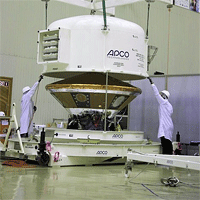
ExoMars 2016 Schiaparelli module

On 14 March, the launch window opens for ExoMars 2016, ESA’s next mission to Mars, composed of the Trace Gas Orbiter and Schiaparelli.

Last month, the two spacecraft left Thales Alenia Space in Cannes, France, where they had been for the final few months of assembly and testing, and headed towards the Baikonur cosmodrome in Kazakhstan.

With both now in …

Read the rest of this article

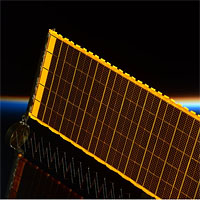
ISS Solar Panels

Sunrise strikes the solar panels that power the International Space Station, caught by ESA astronaut Tim Peake on 31 December 2015.

Follow Tim and his time in space via timpeake.esa.int.

Image credit: ESA/NASA…

Read the rest of this article

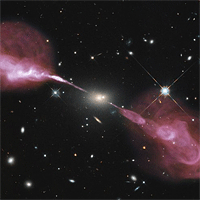
Hercules A Supermassive Black Hole

Scientists often use the combined power of multiple telescopes to reveal the secrets of the Universe – and this image is a prime example of when this technique is strikingly effective.

The yellow-hued object at the centre of the frame is an elliptical galaxy known as Hercules A, seen by the Earth-orbiting NASA/ESA Hubble Space Telescope. In normal light, an …

Read the rest of this article

Philae Lander

One year since Philae made its historic landing on a comet, mission teams remain hopeful for renewed contact with the lander, while also looking ahead to next year’s grand finale: making a controlled impact of the Rosetta orbiter on the comet.

Rosetta arrived at Comet 67P/Churyumov–Gerasimenko on 6 August 2014, and after an initial survey and selection of a landing …

Read the rest of this article

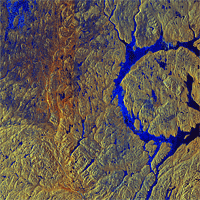
Manicouagan Crater

This false-colour image featuring the Manicouagan Crater was captured by the Sentinel-1A satellite on 21 March.

Carved out by an asteroid strike some 214 million years ago, this crater in Quebec, Canada is known to be one of the oldest and largest impact craters on the planet. Experts believe that glaciers have since played a large part in its erosion.…

Read the rest of this article

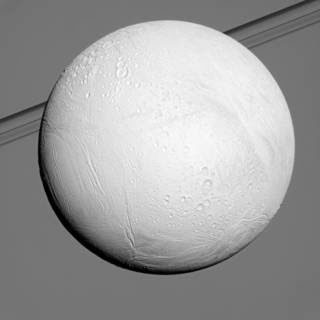
Satrurn's Moon Enceladus

NASA’s Cassini spacecraft will sample the ocean of Saturn’s moon Enceladus on Wednesday, Oct. 28, when it flies through the moon’s plume of icy spray.

Cassini launched in 1997 and entered orbit around Saturn in 2004. Since then, it has been studying the huge planet, its rings and its magnetic field. Here are some things to know about the mission’s …

Read the rest of this article

ExoMars Landing Ellipse

Oxia Planum has been recommended as the primary candidate for the landing site of the ExoMars 2018 mission.

ExoMars 2018, comprising a rover and surface platform, is the second of two missions making up the ExoMars programme, a joint endeavour between ESA and Russia’s Roscosmos. Launch is planned for May 2018, with touchdown on the Red Planet in January 2019.…

Read the rest of this article

Saturn and Dione

Saturn has many, varied moons – over 60 have been discovered so far. One of the larger ones, Dione, is shown here in this image from the Cassini orbiter, pictured as it moved across the face of its parent planet.

Dione orbits Saturn at around 377,400 km, roughly the same distance as that between Earth and the Moon. It has …

Read the rest of this article