Most Distant Galaxy Seen Yet

By pushing NASA’s Hubble Space Telescope to its limits, an international team of astronomers has shattered the cosmic distance record by measuring the farthest galaxy ever seen in the universe. This surprisingly bright, infant galaxy, named GN-z11, is seen as it was 13.4 billion years in the past, just 400 million years after the big bang. GN-z11 is located in …

Read the rest of this article

Stacked images of Mars

Mars Express, ESA’s deep-space probe orbiting the Red Planet, carries a Visual Monitoring Camera that originally provided simple, low-resolution photos of the separation of the Beagle lander. It was then switched off, its prime assignment fulfilled.

In 2007, it was recommissioned as the ‘Mars Webcam’ and has since then provided a wealth of Mars images – including whole-planet views and …

Read the rest of this article

AAVSO Logo Large AAVSO Alert Notice 539
Dwarf novae observations requested for VLA campaign
March 1, 2016

Ms. Deanne Coppejans (PhD candidate, Radboud University Nijmegen (Netherlands) and University of Cape Town) and colleagues have requested AAVSO observer assistance in monitoring several northern dwarf novae in support of their campaign to observe them with the Very Large Array (VLA) in their ongoing radio jet …

Read the rest of this article

AAVSO Logo Large AAVSO Alert Notice 538
Observations of V694 Mon (MWC 560) requested for Chandra campaign
February 26, 2016

Dr. Jeno Sokoloski (Columbia University) and Mr. Adrian Lucy (graduate student, Columbia University) have requested AAVSO observations of the jet-driving symbiotic star V694 Mon (MWC 560), which is in outburst, in support of upcoming Chandra observations to investigate the state of the inner …

Read the rest of this article

AAVSO Logo Large AAVSO Alert Notice 537
Observations of a secondary eclipse of b Persei requested
February 26, 2016

Dr. Donald F. Collins (AAVSO member, Swannanoa, NC), Dr. Robert Zavala (US Naval Observatory, Flagstaff Station), and Jason Sanborn (Lowell Observatory) request high time-resolution observations of the bright eclipsing star b Persei during an expected secondary eclipse of the third star of the system …

Read the rest of this article

This animation visualised milestones during the launch of the ExoMars 2016 mission and its cruise to Mars. The mission comprises the Trace Gas Orbiter and an entry, descent and landing demonstrator module, Schiaparelli, which are scheduled to be launched on a four-stage Proton-M/Breeze-M rocket from Baikonur during the 14–25 March 2016 window.

About ten-and-a-half hours after launch, the spacecraft will …

Read the rest of this article

Philae Lander

Silent since its last call to mothership Rosetta seven months ago, the Philae lander is facing conditions on Comet 67P/Churyumov–Gerasimenko from which it is unlikely to recover.

Rosetta, which continues its scientific investigations at the comet until September before its own comet-landing finale, has in recent months been balancing science observations with flying dedicated trajectories optimised to listen out for …

Read the rest of this article

Asteroid Day

Asteroid Day is an annual global movement to increase public awareness of potential asteroid impacts with Earth, and the importance of guarding against them. It was co-founded in 2015 by Brian May, astrophysicist and lead guitarist for the rock band Queen, Apollo astronaut Rusty Schweickart, and German filmmaker Grig Richters.

The following people spoke at the Tuesday, 9 February press …

Read the rest of this article

AAVSO AAVSO Alert Notice 536
SS Cyg monitoring requested for radio campaign
February 8, 2016

Further to AAVSOSpecial Notice #412, Dr. James Miller-Jones (International Centre for Radio Astronomy Research, Curtin University, Perth, Western Australia) and colleagues have requested AAVSO assistance in support of their multiwavelength (radio and optical) campaign on the dwarf nova SS Cyg. Close monitoring of SS Cyg …

Read the rest of this article

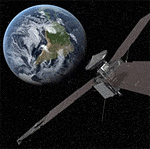
NASA’s Juno mission to Jupiter has broken the record to become humanity’s most distant solar-powered emissary. The milestone occurred at 11 a.m. PST (2 p.m. EST, 19:00 UTC) on Wednesday, Jan. 13, when Juno was about 493 million miles (793 million kilometers) from the sun.

The previous record-holder was the European Space Agency’s Rosetta spacecraft, whose orbit peaked out at …

Read the rest of this article