Yes, you read the title of this correctly. Something big might be about to happen in terms of manned (or possibly robotic) space exploration, outside the remit of NASA and other national, governmental space agencies. Big names like Google, James Cameron and the X-Prize Foundation might be getting into the space mining business!

It’s the kind of thing you’d expect …

Read the rest of this article

Saturn's Moon Titan

A region on Saturn’s moon Titan has been found to be similar to the Etosha Pan in Namibia, Africa. Both are ephemeral lakes – large, shallow depressions that sometimes fill with liquid.


Ontario Lacus is Titan’s largest lake in its southern hemisphere. It is an ephemeral lake that resembles Etosha Pan in Namibia, Africa. On Titan the liquid is made …

Read the rest of this article

Mercury, the closest planet to the Sun, remains somewhat of a mystery to us.


The BepiColombo mission will place two orbiters around Mercury: the European-made Mercury Planetary Orbiter (MPO), seen here, that will map the planet, and Japanese-made Mercury Magnetospheric Orbiter (MMO), that will investigate its magnetosphere. Credits: ESA – P. Carril

In the past, because of its proximity to …

Read the rest of this article

NASA will celebrate the 42nd anniversary of Earth Day this week with several live and online activities to engage the public about the agency’s mission to use space to explore and better understand our planet.

NASA will host three days of displays and presentations open to the public on the National Mall in Washington from Friday, April 20, through Earth …

Read the rest of this article

Saturn’s icy moon Enceladus hangs below the gas giant’s rings while Titan lurks in the background, in this new image taken by the Cassini spacecraft.

Faint detail of the tiger stripe markings can be seen on Enceladus’ surface, which is framed against Titan, Saturn’s largest moon. With jets of water ice and vapour streaming from Enceladus’ south pole, and liquid …

Read the rest of this article

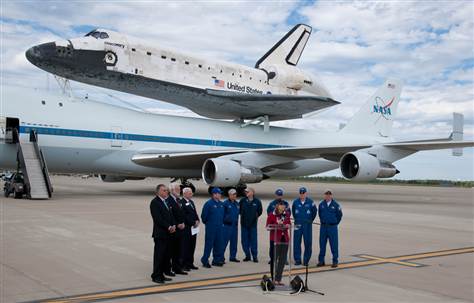
“Following are excerpts from remarks given by NASA Deputy Administrator Lori Garver at the arrival of the space shuttle Discovery at Dulles International Airport on Tuesday, April 17:

“Discovery was the longest-serving veteran of NASA’s space shuttle fleet. Her maiden voyage was in 1984. She flew 39 missions, spent 365 days in space, orbited Earth 5,830 times and traveled 148,221,675 …

Read the rest of this article

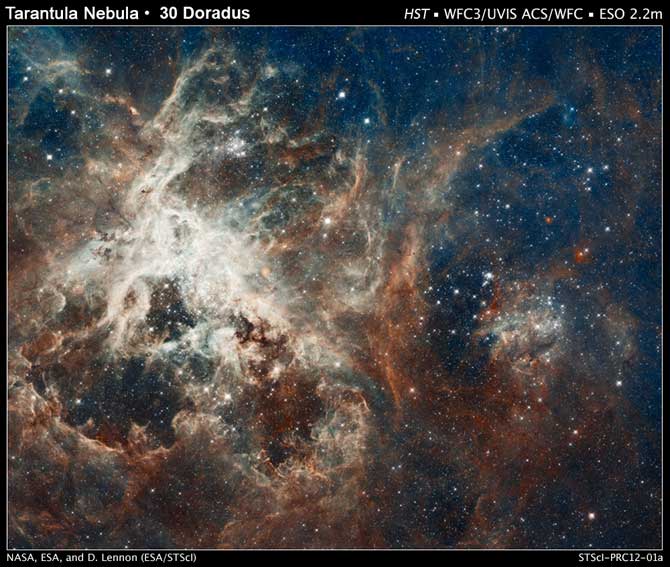
Several million young stars are vying for attention in a new NASA Hubble Space Telescope image of a raucous stellar breeding ground in 30 Doradus, a star-forming complex located in the heart of the Tarantula nebula.


The image comprises one of the largest mosaics ever assembled from Hubble photos and includes observations taken by Hubble’s Wide Field Camera 3 and …

Read the rest of this article

A full-scale test version of the Orion spacecraft is one of several NASA-sponsored exhibits that will appear alongside space shuttle Discovery at the National Air and Space Museum’s Steven F. Udvar-Hazy Center near Washington Dulles International Airport in Chantilly, Va.


This artist’s rendering represents the crew module of the Orion crew exploration vehicle with the outer skin removed revealing the …

Read the rest of this article

On April 16th around 17:45 UT, magnetic fields curling over the sun’s northeastern limb rose up and erupted, producing one of the most visually-spectacular explosions in years.

The event, which also produced an M1.7-class solar flare and a coronal mass ejection, was not Earth-directed. Nevertheless, it confirms suspicions that a significant active region is rotating onto the Earth-side of the …

Read the rest of this article

NASA

NASA Television will broadcast the departure of one Russian Progress cargo ship from the International Space Station (ISS) and the arrival of another beginning on Thursday, April 19.

ISS Progress 46, which arrived at the station in January and has been filled with trash for disposal, will undock from the Pirs docking compartment at 6:03 a.m. CDT April 19. Russian …

Read the rest of this article