The Sun

Huge sunspot AR1476 is crackling with M-class solar flares and appears to be on the verge of producing something even stronger.

The sunspot’s ‘beta-gamma-delta’ magnetic field harbors energy for X-class flares, the most powerful kind.

Radio operators are recording strong bursts of shortwave static from the sunspot as it turns toward Earth. Visit http://spaceweather.com for sample recordings and forecasts.

Solar …

Read the rest of this article

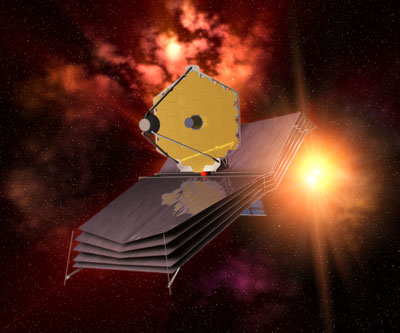
The first instrument to be completed for the James Webb Space Telescope, MIRI, was handed over by the European consortium that built it to ESA at a ceremony held in London today, and will now be delivered to NASA aiming for launch in 2018.


MIRI, the Mid Infrared Instrument, being prepared for vibration testing at the Science and Technology Facilities …

Read the rest of this article

NASA’s Spitzer Space Telescope has detected light emanating from a “super-Earth” planet beyond our solar system for the first time. While the planet is not habitable, the detection is a historic step toward the eventual search for signs of life on other planets.


NASA’s Spitzer Space Telescope was able to detect a super Earth’s direct light for the first time …

Read the rest of this article

Expedition 31 Flight Engineer Don Pettit of NASA has taught more than half a million internet viewers how microgravity affects scientific principles by using everyday objects on the International Space Station. In the latest video, Pettit takes his demonstrations to the next level by using sound to oscillate water placed on a speaker and letting the droplets fly.

Don Pettit …

Read the rest of this article

Mars

ESA’s Mars Express has returned images of a region on the Red Planet that appears to have been sculpted in part by flowing liquid. This again adds to the growing evidence that Mars had large volumes of water on its surface in the distant past.


The transition between Acidalia Planitia and Tempe Terra from the Mars Express High-Resolution Stereo Camera …

Read the rest of this article

The full Moon has a reputation for trouble. It raises high tides, it makes dogs howl, it wakes you up in the middle of the night with beams of moonlight stealing through drapes. If a moonbeam wakes you up on the night of May 5th, 2012, you might want to get out of bed and take a look. This May’s …

Read the rest of this article

Jupiter’s icy moons are the focus of Europe’s next large science mission, ESA announced today.

The Jupiter Icy moons Explorer – JUICE – was selected over two other candidates: NGO, the New Gravitational wave Observatory, to hunt for gravitational waves, and ATHENA, the Advanced Telescope for High-Energy Astrophysics.


The Jupiter Icy Moons Explorer. Credits: ESA/AOES

Read the rest of this article

Astronomers have gathered the most direct evidence yet of a supermassive black hole shredding a star that wandered too close. NASA’s Galaxy Evolution Explorer, a space-based observatory, and the Pan-STARRS1 telescope on the summit of Haleakala in Hawaii were among the first to help identify the stellar remains.


This computer-simulated image shows gas from a tidally shredded star falling into …

Read the rest of this article

An extraordinary outburst produced by a black hole in a nearby galaxy has provided direct evidence for a population of old, volatile stellar black holes. The discovery, made by astronomers using NASA’s Chandra X-ray Observatory, provides new insight into the nature of a mysterious class of black holes that can produce as much energy in X-rays as a million suns …

Read the rest of this article

Research by NASA and international scientists concludes giant asteroids, similar or larger than the one believed to have killed the dinosaurs, hit Earth billions of years ago with more frequency than previously thought.

To cause the dinosaur extinction, the killer asteroid that impacted Earth 65 million years ago would have been almost 6 miles (10 kilometers) in diameter. By studying …

Read the rest of this article