Findings from NASA’s Dawn spacecraft reveal new details about the giant asteroid Vesta, including its varied surface composition, sharp temperature changes and clues to its internal structure. The findings were presented today at the European Geosciences Union meeting in Vienna, Austria and will help scientists better understand the early solar system and processes that dominated its formation.


These composite images …

Read the rest of this article

NASA

The NASA Innovative Advanced Concepts (NIAC) Program is seeking proposals to continue promising studies for which it has supported the first phase. These cutting-edge concepts have the potential to transform future exploration missions, enable new capabilities, or significantly alter current approaches to launching, building, and operating aerospace systems.

“These transformative concepts have the potential to mature into the new capabilities …

Read the rest of this article

Saturn's Moon Titan

Saturn’s giant moon Titan hides behind a thick, smoggy atmosphere that’s well known to scientists as one of the most complex chemical environments in the solar system. It’s a productive “factory” cranking out hydrocarbons that rain down on Titan’s icy surface and cloak it in soot. With a brutally cold surface temperature of around minus 270 degrees Fahrenheit (minus 170 …

Read the rest of this article

While some galaxies are rotund and others are slender disks like our spiral Milky Way, new observations from NASA’s Spitzer Space Telescope show that the Sombrero galaxy is both. The galaxy, which is a round elliptical galaxy with a thin disk embedded inside, is one of the first known to exhibit characteristics of the two different types. The findings will …

Read the rest of this article

An explosion over California that rattled homes across at least two states on Sunday, April 22nd, has been analyzed by NASA’s Meteoroid Environment Office: According to Bill Cooke, head of NASA’s Meteoroid Environment Office, it was a natural meteoroid the size of a mini-van. Analysts say the space rock exploded in the atmosphere with an energy equal to nearly 4 …

Read the rest of this article

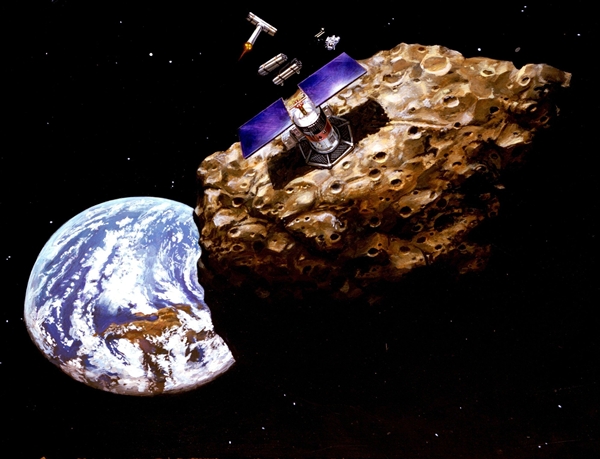
Seattle, Wash. – April 24, 2012 — Planetary Resources, Inc. announced today its plan to mine Near-Earth Asteroids (NEAs) for raw materials, ranging from water to precious metals. Through the development of cost-effective exploration technologies, the company is poised to initiate prospecting missions targeting resource-rich asteroids that are easily accessible.

Resource extraction from asteroids will deliver multiple benefits to humanity …

Read the rest of this article

Following on from my post a couple of days ago about how a number of Tech Billionaires and high-flyers have gotten together to create a private space program, I came across this article which provides a lot more detail about their plans…

There’s gold in them there hills. You know, those ones floating around in space. Asteroids contain many tons …

Read the rest of this article

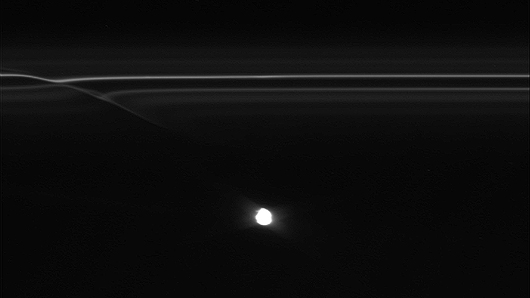
Scientists working with images from NASA’s Cassini spacecraft have discovered strange half-mile-sized (kilometer-sized) objects punching through parts of Saturn’s F ring, leaving glittering trails behind them. These trails in the rings, which scientists are calling “mini-jets,” fill in a missing link in our story of the curious behavior of the F ring. The results will be presented tomorrow at the …

Read the rest of this article

Optical, radar and laser observations of the Envisat satellite show that it is still in a stable orbit. Efforts to regain contact with the satellite have been under way since 8 April, when it unexpectedly stopped sending data to Earth.


On 15 April, the French space agency CNES rotated the Pleiades Earth observation satellite to capture this image of Envisat. …

Read the rest of this article

Last month, when the sun unleashed the most intense radiation storm since 2003, peppering satellites with charged particles and igniting strong auroras around both poles, a group of high school students in Bishop, California, knew just what to do. They launched a rubber chicken.

Camilla at ~124,800 feet on March 3, 2012.

The students inflated a helium balloon and used …

Read the rest of this article